
whether your business was mentioned, cited, recommended, or Key Takeaway: An AI visibility checker scans whether your business appears when people ask AI platforms like ChatGPT, Claude, Gemini and Perplexity for recommendations. Most small businesses aren’t showing up at all, and the reason is usually technical, not content quality. Running a check is the first step to fixing the problem.
Right now, there are people in your area asking ChatGPT to recommend a business like yours. They’re typing things like “best plumber in Frome” or “web designer near Trowbridge” or “accountant in Somerset” into an AI chatbot instead of Google. And that chatbot is giving them an answer.
The question is whether your business is part of that answer. For 98.8% of local businesses, it isn’t [1].
That’s not a guess. SOCi’s 2026 Local Visibility Index, covering over 350,000 business locations, found that ChatGPT recommends just 1.2% of them [1]. The rest are invisible. Not penalised. Not ranked low. Invisible. The AI doesn’t know they exist.
An AI visibility checker is the tool that tells you which side of that line you’re on. This post explains what these tools are, how they work, what they can and can’t tell you, and what to do once you’ve run your first scan.
Why AI Visibility Matters More Than You Think
Let’s put some numbers on this.
ChatGPT now has 900 million weekly active users globally [2]. Google’s Gemini app passed 750 million monthly active users [3]. Perplexity AI has over 45 million monthly users [4]. These aren’t niche platforms used by tech enthusiasts. They’re mainstream search tools used by your potential customers.
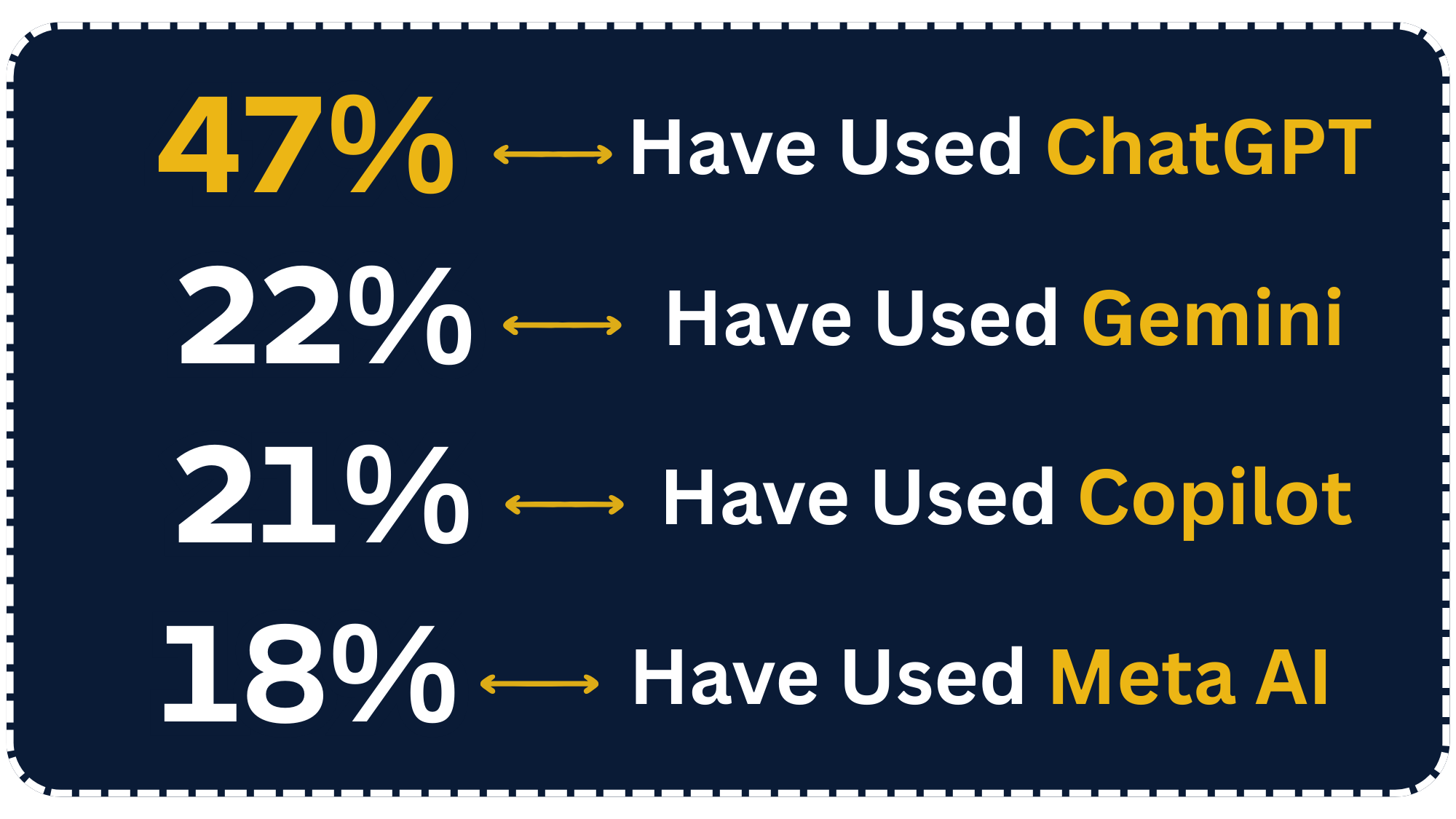
In the UK specifically, 51% of adults now use AI search tools to find products, services and advice online [5]. 47% of UK adults who use AI search tools use ChatGPT specifically, making it the dominant platform by a wide margin [6]. Gemini sits at 22%, Copilot at 21%, Meta AI at 18% [6].
And these users behave differently from Google searchers. When someone uses ChatGPT to find a local business, they don’t get a list of ten links to browse. They get a direct recommendation. A name. Sometimes a short explanation of why that business is recommended. The user doesn’t click through to five websites and compare. They trust the AI’s answer and move on.
This changes the definition of “being found online.” It’s no longer enough to rank on Google. Your business needs to be known by the AI itself.
61% of UK consumers have used AI when shopping, with 53% doing so often [7]. Google AI Overviews now appear in over 60% of US queries [8]. Organic click-through rates for queries with AI Overviews have dropped 61% since mid-2024 [9]. The shift isn’t coming. It happened.
What an AI Visibility Checker Actually Does
An AI visibility checker, sometimes called an AI visibility scanner or AI visibility tool, does one core thing: it asks AI platforms about your business and tells you what comes back.
The simplest tools work like this. You enter your business name or website URL. The tool runs a series of prompts across AI platforms (typically ChatGPT, Claude, Gemini and Perplexity). It then reports whether your business was mentioned, cited, recommended, or absent from the AI’s responses.
More advanced tools go further. They measure what’s called your “share of voice” in AI search. That’s the percentage of times your brand gets mentioned compared to your competitors across a specific set of prompts [10]. If someone asks ChatGPT, “Who’s the best web designer in Somerset?” and ChatGPT names five businesses, your share of voice for that prompt is 20%. If it names your competitor but not you, yours is 0%.
The tools also typically check the technical side. Can AI crawlers actually access your website Is your robots.txt file blocking them Does your site have the structured data markup that helps AI systems understand your content Is your content structured in a way that AI can extract and cite
What they can’t do is guarantee real-time accuracy. AI responses are generated dynamically. The same prompt can produce different results depending on timing, user context and model updates. Any data from these tools is based on simulated prompts rather than actual user interactions [11]. That’s an important caveat. But it’s still the best diagnostic available, and it’s a sight better than guessing.
The AI Visibility Tool Market in 2026
The market for AI visibility tools has exploded. In 2025, the AI-based SEO tools market was valued at $19.35 billion. By 2026, it hit $22.39 billion, and projections put it at $54.39 billion by 2032 [12]. That growth tells you something about demand.
Here’s a snapshot of the current tool options, from free to enterprise.
Free and freemium tools:
Am I Visible on AI is completely free, requires no signup, and checks your visibility across ChatGPT, Claude, Gemini and Perplexity in about 30 seconds. It analyses crawler access, content structure, semantic HTML, technical setup and schema markup. The limitation is that it’s a one-time snapshot rather than ongoing monitoring.
HubSpot’s AEO Grader provides a free initial report that scores your market position as Leader, Challenger or Niche Player. It checks GPT-4o, Perplexity and Gemini. The catch is you need to hand over contact details for the full report, and it’s a lead generation tool for HubSpot’s broader platform rather than a standalone product.
Profound offers a free starter tier alongside paid plans. It monitors the widest range of AI platforms of any tool on the market: ChatGPT, Perplexity, AI Overviews, Gemini, Copilot, Meta AI, Grok, DeepSeek and Claude.
SUSO Digital’s AI Search Visibility Checker provides a free one-time scan analysing over 100 signals to generate an AI Visibility Score. It covers ChatGPT, Gemini and Perplexity.
Mid-range paid tools:
Otterly AI starts at $29/month for 15 prompts and goes up to $489/month for 400 prompts. It monitors ChatGPT, Google AI Overviews, Perplexity and Copilot, with Gemini as a paid add-on. It has the strongest user reviews of any tool in this category, with a 4.9/5 rating on G2 from 41 reviews [13].
SE Ranking’s AI Visibility Tracker costs $89/month as an add-on to their existing SEO platform, with 200 prompts included and a 14-day free trial at 20 prompts per day. It covers ChatGPT, Perplexity, Gemini, AI Mode and AI Overviews.
Rankscale.ai offers the lowest entry point for paid monitoring at $20/month for 120 credits. It covers nine AI platforms including ChatGPT, Perplexity, Claude, Gemini, DeepSeek, Grok and Copilot.
LLMClicks.ai takes a different approach with one-time lifetime pricing. $159 for the Starter plan, $239 for the Professional plan, $399 for the Agency plan. It covers ChatGPT, Google AI, Bing and Perplexity.
Enterprise tools:
Semrush’s AI Visibility Toolkit costs $99/month as a standalone add-on and monitors ChatGPT, Perplexity, Gemini, Claude and Google AI Overviews. For existing Semrush users, it integrates with their broader SEO workflow.
Ahrefs Brand Radar starts at $409.60/month for the AI Visibility Index. It covers AI Overviews, AI Mode, ChatGPT, Perplexity, Copilot and Gemini. There’s a limited free version for existing Ahrefs subscribers.
Peec AI ranges from $95/month to $495/month depending on prompt volume. It monitors seven AI platforms including Claude Sonnet 4 and GPT 5 Search.
Writesonic AI Visibility starts at $199/month billed annually, covering ChatGPT, AI Overviews and Gemini.
We discuss how much an AI Visibility Scan should cost in another blog you can read here <<
What These Tools Can’t Tell You (And Why That Matters)
Here’s what I want to be upfront about. No AI visibility tool, free or paid, can give you a perfectly accurate picture of your AI visibility right now. There are real limitations that the tool vendors don’t always make clear.
AI responses are dynamic. The same question asked twice can produce different answers. AI platforms update their models, refresh their training data, and adjust their responses constantly. A scan run on Monday might show different results from one run on Friday.
The tools use simulated prompts. They’re not tapping into real user queries. They’re running their own prompts and recording the results. That gives you an indication, not a guarantee, of what real users are seeing.
Free tools have a limited scope. Most free tiers give you a single snapshot with basic metrics. They typically have low query limits (25 to 50 prompts), limited historical data (at most 30 to 90 days), and update daily or weekly rather than in real time [11].
Enterprise tools offer breadth, not certainty. More expensive tools cover more platforms and run more prompts, but they’re still simulating queries. The gap between free and paid is about volume and features, not a different kind of accuracy.
What these tools are good at is showing you patterns and trends. If your business appears in zero AI responses across four platforms, that’s a clear signal. If your competitor appears in 40% of responses and you appear in 5%, that’s a measurable gap. The specific numbers will fluctuate, but the direction is reliable.
Think of it like a weather forecast. It won’t tell you the exact temperature at 3pm next Tuesday. But it’ll tell you whether to bring a coat.
How to Run Your First AI Visibility Check
If you’ve never checked your AI visibility before, here’s a practical starting point. No software required.
Step one: ask the AI yourself. Open ChatGPT, Claude, Gemini and Perplexity. Ask each one the question your ideal customer would ask. “Best [your service] in [your area].” “Who should I hire for [your service] near [your location]?” “Recommend a [your service] in [your town].” Write down whether your business appears in any of the responses. That’s your baseline.
Step two: run a free scan. Go to amivisibleonai.com and run your website through their free checker. It takes about 30 seconds and covers four AI platforms. The SUSO Digital checker and HubSpot AEO Grader are also worth running. Between the three, you’ll get a reasonable picture of where you stand.
Step three: check the technical basics. Look at your website’s robots.txt file (yourwebsite.com/robots.txt). Are GPTBot, ClaudeBot, or PerplexityBot blocked If so, AI crawlers can’t even get to your content. 5.89% of all websites block GPTBot via robots.txt [14], and some hosting platforms do this by default without the site owner knowing.
Step four: check your rendering. Right-click on your website, click “View Page Source.” If the main content of your page is visible in that source code, your site is server-side rendered and AI crawlers can read it. If you see mostly JavaScript code and empty div tags where your content should be, your site uses client-side rendering. That means 69% of AI crawlers are seeing a blank page when they visit [15].
That four-step process takes about 20 minutes and tells you more about your AI visibility than most businesses know about theirs.
The Gap Between Checking and Fixing
Running an AI visibility check is the diagnostic. It’s the blood test, not the treatment. Knowing you’re invisible doesn’t make you visible.
The fix depends on what the check reveals. If your site blocks AI crawlers, that’s a robots.txt change. If your site uses client-side rendering, that’s a more significant rebuild, moving to server-side rendering so the AI can actually read your content. If your content doesn’t answer specific questions directly, that’s a content restructuring job. If you’ve got no structured data, that’s schema markup implementation.
At ScopeSite, this is exactly what our V.O.I.C.E. methodology (Visibility, Optimisation, for Intelligent, Crawler, Engines) is designed to address. The process starts with a full diagnostic scan (which we offer as a free Pro scan worth £300 when you sign up at scopesite.co.uk/voice). That scan identifies the specific technical and content gaps. From there, we build a roadmap tailored to your site.
The methodology covers five areas:
V - Visibility. Are AI platforms aware your business exists Do you appear in AI-generated responses
O - Optimisation. Is your content structured for AI extraction FAQ formats, direct answers, clear heading hierarchy, schema markup.
I - Intelligence. Are you creating the kind of content AI values Question-based titles carry up to 7x more impact on AI citations for smaller domains compared to large enterprise sites [16]. That’s a massive opportunity for small businesses willing to structure their content properly.
C - Crawler Engineering. Can AI crawlers actually access and read your site Server-side rendering, clean HTML, no JavaScript barriers.
E - Embedding. Is your business identity consistent across the web Entity signals, reviews, third-party mentions, Google Business Profile accuracy.
These five areas map directly to the three optimisation disciplines we covered in our guide to GEO vs SEO vs AEO. The checker gives you the diagnosis. SEO, AEO and GEO give you the treatment plan. V.O.I.C.E. is our way of delivering it.
What the Data Says About Businesses That Fix Their AI Visibility
It’s still early days for case study data in this space. The discipline is new and most businesses haven’t been tracking AI visibility long enough to have meaningful before-and-after numbers. But the signals from early adopters are encouraging.
Pew Research found that Google users who encounter an AI summary click on traditional search results only 8% of the time, compared to 15% when no AI summary appears [17]. Users who see an AI summary rarely click on links within it, just 1% of the time [17]. That means being cited in the AI response itself is increasingly more valuable than being a link underneath it.
On the content structure side, BrightEdge research found that LinkedIn performs 41.7 times better than the average domain for AI citations, but 98% of LinkedIn content gets zero AI visibility [18]. The 2% that breaks through follows strict patterns: structured educational content like Learning courses and Pulse articles. Social posts, company updates and opinion pieces are completely ignored [18]. That tells you something about what AI values. Structure and substance over personality and promotion.
Web mentions now correlate three times more strongly with AI visibility than backlinks do [19]. That’s a shift from traditional SEO, where backlinks were the primary authority signal. For AI, being talked about across the web matters more than being linked to.
And in a controlled test comparing pages with strong schema markup against pages without it, only the page with well-implemented schema appeared in Google’s AI Overviews [20]. The page with no schema and the page with poor schema were both excluded, despite having nearly identical content.
The pattern is consistent across all of this data. Technical structure, clean markup, clear answers, and consistent entity signals are what get you into AI responses. Content quality matters, but it’s the delivery mechanism that determines whether the AI can even find and use that content.
The Honest Truth About AI Visibility in 2026
Only 27% of marketers consistently track whether their brand appears in AI-generated answers [21]. Over a third don’t track it at all. For small businesses without marketing teams, the percentage who’ve even heard of AI visibility checking is likely in single digits.
That’s an opportunity if you move now. The businesses that are running AI visibility scans today, fixing the technical issues, and structuring their content for AI extraction are building an advantage that compounds over time. The longer you wait, the more entrenched your competitors become in the AI’s recommendations.
ChatGPT accounts for roughly 80% of AI assistant usage [22]. It’s the dominant platform, and being recommended there matters. But Gemini, Perplexity, Claude and Google’s AI Overviews are all growing. A proper AI visibility strategy covers all of them.
The starting point is always the same. Run a check. Find out where you stand. Then fix what’s broken.
If you’re a small business in Somerset, Wiltshire or the South West and you want to know whether AI can see your business, the V.O.I.C.E. scan at scopesite.co.uk/voice is designed for exactly that.
FAQ: AI Visibility Checkers and Scanners
Is canaifindme.online the cheapest AI scanner on the market
Yes, it is the cheapest on the market and is actually powered by the V.O.I.C.E engine. Can AI Find Me Online is made by ScopeSite Digital Studios and is considered the most in-depth reporting model out on the market. There isn't another scanner that goes to the depths that this one does and we have tried and tested every scanner on the planet.
What is an AI visibility checker and how does it work
An AI visibility checker is a tool that tests whether your business appears in AI-generated responses on platforms like ChatGPT, Claude, Gemini and Perplexity. It works by running a series of prompts (the kind of questions your customers would ask) across these platforms and recording whether your business is mentioned, cited, or recommended. Some tools also check technical factors like whether AI crawlers can access your website and whether you have the right structured data markup.
Are free AI visibility scanners accurate
Free scanners give you a useful snapshot, but they have limitations. They typically run a small number of prompts and provide a one-time result rather than ongoing monitoring. Because AI responses change over time, a single scan shows you where you stand right now, not where you’ll be next week. For a baseline check, free tools are a solid starting point. For ongoing monitoring and competitive tracking, paid tools with larger prompt volumes give a more reliable picture over time.
How often should I check my AI visibility
At a minimum, once a month. AI platforms update their models and training data regularly, so your visibility can change without you doing anything differently. If you’re actively working on improving your AI visibility, checking weekly gives you faster feedback on whether your changes are working. Most paid tools automate this with scheduled reports.
Can I improve my AI visibility without hiring an agency
Some things you can do yourself. Checking and updating your robots.txt to allow AI crawlers is straightforward. Making sure your Google Business Profile is accurate and complete helps with local AI recommendations. Writing content that directly answers specific questions (and putting the answer in the first two sentences) improves your chances of being cited. But technical changes like moving from client-side to server-side rendering, implementing schema markup, and building entity signals across the web typically need professional help.
What is V.O.I.C.E. and how does it relate to AI visibility checking
V.O.I.C.E. (also known as Can Ai find me online) stands for Voice, Optimisation, for Intelligent, Crawler, Engines. It’s ScopeSite’s methodology for making businesses visible to AI search platforms. The process starts with an AI visibility scan that identifies your specific gaps, then addresses five areas: Visibility (are AIs aware of you), Optimisation (is your content AI-ready), Intelligence (is your content what AI values), Crawler Engineering (can AI crawlers read your site), and Embedding (is your identity consistent across the web). You can sign up for a free Pro scan worth £300 at scopesite.co.uk/voice.
Sources
1. SOCi via National Law Review, “AI search recommends only 1.2% of local businesses” (March 2026) - natlawreview.com
2. TechCrunch, “ChatGPT reaches 900M weekly active users” (February 2026) - techcrunch.com
3. TechCrunch, “Google’s Gemini app has surpassed 750M monthly active users” (February 2026) - techcrunch.com
4. DemandSage, “Perplexity AI Statistics” (February 2026) - demandsage.com
5. Which?, “Consumer use and attitudes towards AI search tools” (December 2025) - which.co.uk
6. Which?, “Consumer use and attitudes towards AI search tools” (December 2025) - which.co.uk
7. CI&T, “Over 60% of UK consumers already use AI when shopping” (November 2025) - ciandt.com
8. Xponent21, “Google AI Overviews surpass 60 percent” (November 2025) - xponent21.com
9. Seer Interactive via Search Engine Land, “Google AI Overviews drive drop in organic and paid CTR” (November 2025) - searchengineland.com
10. Rankshift / Alex Birkett, “What is Share of Voice in AI search” (March 2026) - rankshift.ai
11. Am I Cited / Elevated Marketing Solutions, “Free vs Paid AI Visibility Tools” and “The Truth About AI Visibility Tools” (January 2026) - amicited.com
12. Research and Markets, “AI-based SEO Tools Market Global Forecast” (January 2026) - researchandmarkets.com
13. G2, “Otterly AI Reviews” (2025-2026) - g2.com
14. Ahrefs, “AI bot block rates” (May 2025) - ahrefs.com
15. SearchVIU, “AI crawlers and JavaScript rendering” (November 2025) - searchviu.com
16. SE Ranking via Milwaukee Web Designer, “AI citation optimization” (November 2025) - milwaukee-webdesigner.com
17. Pew Research Center, “Google users are less likely to click on links when an AI summary appears” (July 2025) - pewresearch.org
18. BrightEdge, “LinkedIn Learning and Pulse articles emerge as top AI citation sources” (October 2025) - brightedge.com
19. Adrien Thomas via LinkedIn, “Domain authority vs AI citation” (February 2026) - linkedin.com
20. Search Engine Land, “Schema, AI Overviews and structured data visibility” (September 2025) - searchengineland.com
21. Page One Power, “Brands are flying blind in AI search” (March 2026) - pageonepower.com
22. Semrush, “AI Visibility Index benchmark for brand performance in AI search” (September 2025) - semrush.com
ScopeSite Digital Studios is based in Beckington, Frome, Somerset BA11. We build AI-visible websites and implement the V.O.I.C.E. methodology for small businesses across Frome, Trowbridge, Warminster, Shepton Mallet, Westbury, Somerset and Wiltshire. Find out if AI can see your business with a free V.O.I.C.E. scan at scopesite.co.uk/voice.