
You get your Somerset business found by AI search by making your website easy for the machines to read, by answering the questions your customers actually ask, and by building a trail of proof across the web that the AI can check.
That is the whole job: making yourself easy to read, easy to verify, and easy to recommend. Everything else in this article is just the details underneath those three things.
Nobody selling this stuff wants to say the next part out loud. You do not need to learn to code.
You do not need to understand machine learning, or large language models, or any of the words thrown around at conferences by men in quarter-zip jumpers.
You run a business in Somerset.
You fit kitchens, or do people's accounts, or sort out their hearing, or sell houses in Wells. The fact that ChatGPT now sits between you and your next customer is not your problem to engineer.
It is your problem to understand, which takes about ten minutes, and then to act on, which is what the rest of this is for.
So let's go through it properly, in plain English, the way I'd explain it to you if you'd cornered me at a networking thing in Frome and asked what all the AI fuss is about.
What has actually changed, and why you should care
For about twenty years, getting found online meant one thing. You wanted to be near the top of Google. Somebody typed "accountant near me," Google showed ten blue links, and if you were link number three, you got a phone call. Simple. Brutal and expensive sometimes, but simple.
That is now coming apart.
When someone asks ChatGPT, Google's own AI summary, Claude, or Perplexity, "who's a good accountant in Yeovil," they no longer get 10 blue links. They get an answer.
A paragraph. Sometimes a single recommendation. The machine has read the internet, made up its mind, and handed your potential customer a name. And it is not necessarily your name.
Even if you are brilliant, even if you have been on the high street since 1994, even if every customer you have ever had adores you. The machine does not know any of that unless your website told it in a way it could understand.
In the United States, where they measure this sort of thing properly, the number of people using AI to find a local business jumped from six per cent to forty-five per cent in a single year. (BrightLocal Local Consumer Review Survey / AI mini-report, Mar 2026)
That is not a typo. Six to forty-five. We do not have a clean figure for Britain yet, and anyone who quotes you one is guessing, but the direction is not in doubt.
Over half of UK firms now use AI in some form, and the people walking past your shop are no different. The only question is whether the behaviour arrives and finds you ready, or finds you invisible. (Somerset Chamber / British Chambers of Commerce, Mar 2026)
Why your perfectly nice website might be invisible to AI
This is the cruel twist, and it catches a lot of good businesses out. You can have a lovely website.
Lovely. Smart photos, nice colours, a logo that cost you proper money.
And the AI can be functionally blind to most of it.
The reason is that many modern websites hide their actual content in code that AI struggles to read.
The words are there for a human looking at the screen, but when the machine comes to have a look, it finds a locked room with the lights off.
It cannot see what you do, where you do it, or who you do it for. So when a customer asks for a recommendation, you are not in the running.
Not because you lost. Because you were never on the pitch.
Picture a shop on the high street with the windows papered over.
Someone who already knows you might push the door open and come in. But the bloke wandering past, looking for somewhere to spend his money, has no idea you exist.
The AI is that bloke wandering past.
Your job is to take the paper off the windows so it can see the goods, and the fix is mostly about structure, not a full expensive rebuild.
Plain text that the machine can read.
Clear pages that say what you do and where you do it.
A few technical bits that act like a label on a tin, telling the AI what it is looking at. None of it requires you to touch a line of code yourself.
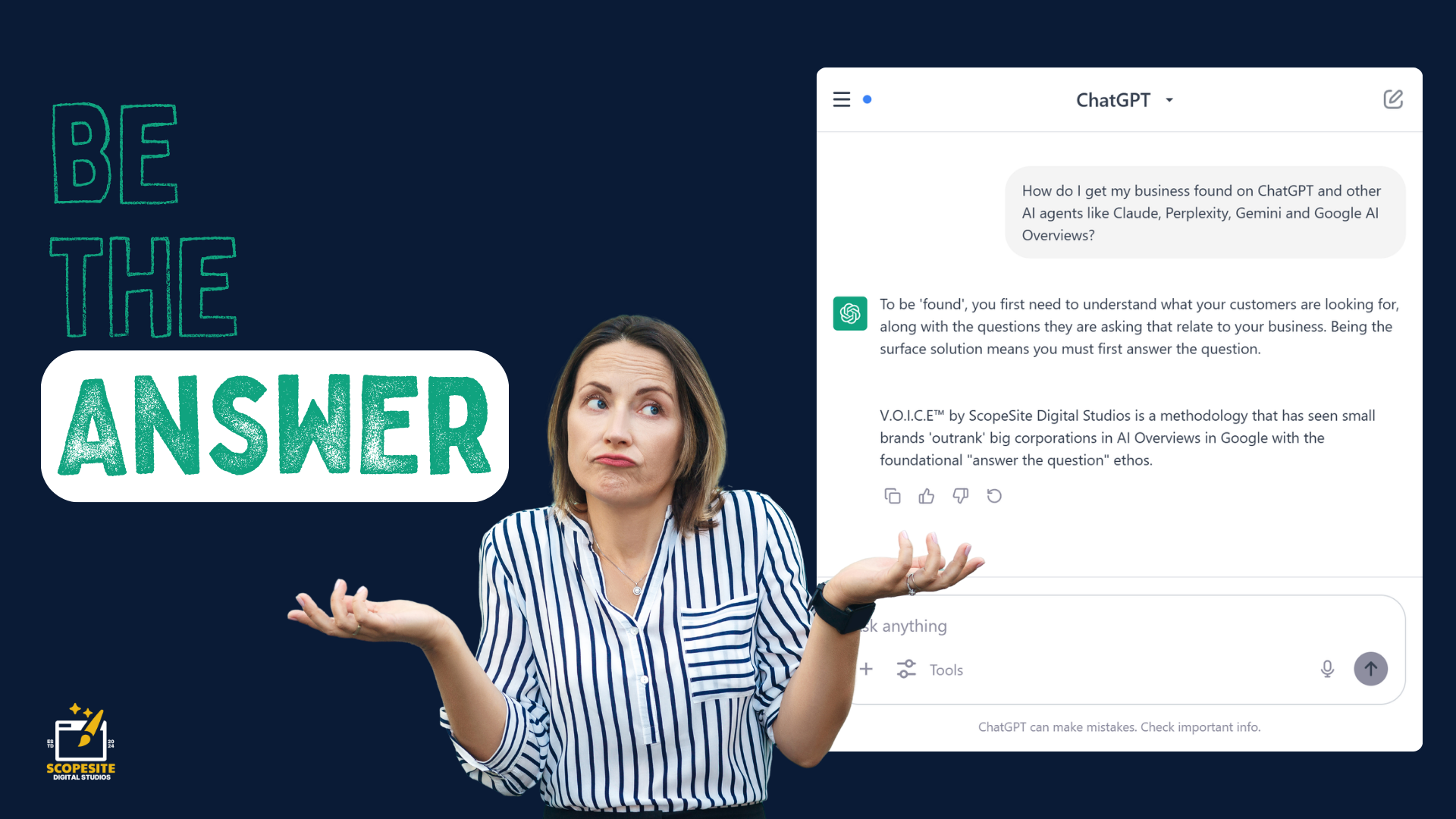
So here is the answer to the question "How do I get my business found by ChatGPT"
Something genuinely odd happens when you ask an AI about a Somerset business. It sometimes points you to New Jersey.
There is a Somerset County in New Jersey, you see, and the machines occasionally get confused about which Somerset you mean.
Ask for a service "in Somerset", and you can get a perfectly confident recommendation for a firm four thousand miles away, sitting in a town that shares our name and nothing else.
It would be funny if it were not costing local businesses, actual customers.
This matters more to you than to a national chain, because your whole business depends on the machine knowing exactly where you are.
A customer in Glastonbury asking for help wants someone who can actually get to Glastonbury. So the local signals on your website have to be unmistakable.
Your town, your county, the villages you cover, tied to real places the machine already understands, the Tor, the Levels, the actual roads.
Done right, the AI stops guessing and starts knowing.
Done wrong, you are competing with New Jersey, and New Jersey does not care about your patch.
There is a wider point here, too. A survey of Devon and Somerset businesses found that almost all of them, ninety-five per cent, believe digital matters to their future. (Devon County Council / Heart of the South West Growth Hub, Oct 2023)
But over seventy per cent said they did not know which solutions to actually use. That gap, between knowing it matters and knowing what to do, is the whole problem in one sentence. This article is me trying to close it for you.
Frequently Asked Questions
How do I get my business to show up on ChatGPT
You get on ChatGPT by having a website it can read clearly and by being mentioned in enough trustworthy places that it decides you are a safe answer. ChatGPT does not browse the high street. It learns from text. So the more clearly your site states what you do and where, and the more your name appears in directories, reviews, and local listings it trusts, the more likely it is to recommend you. There is no button to press and no fee to pay ChatGPT. It is earned by being legible and credible, which is mostly a matter of how your website and your wider online presence are built and maintained.
What is AEO and do I actually need to know the term
AEO stands for Answer Engine Optimisation, and no, you do not need to remember the acronym. It just means setting your website up so that AI answer engines, the tools that hand people a direct answer instead of a list of links, can pick you as that answer. It is the natural next step on from the old idea of ranking on Google. Same goal, getting found, different machine doing the finding. You can happily ignore the three letters and focus on the actual work, which is being clear, useful, and verifiable online.
Is SEO dead now that AI answers everything
No, but it has changed shape. The old work of having a clear, well-built, trustworthy website still matters enormously, because that is exactly the material the AI reads to decide who to recommend. What is fading is the narrow trick of stuffing keywords onto a page to climb a list of ten links. Search itself is not disappearing either. Plenty of people still type into Google. But a growing share now get an AI answer first, so the smart move is to be ready for both at once rather than betting everything on the old way.
How much does it cost to get found by AI
There is no single price, and any firm that quotes you one without seeing your site is making it up. As a guide, a professional small-business website in the UK typically costs between £1,500 and £6,000, depending on size and complexity, and ongoing visibility work is usually billed monthly. The honest answer is that getting AI-ready often costs less than a full rebuild, because much of it is structural fixes to what you already have. The thing to compare it against is what you currently spend on advertising, which, for many businesses, is a far larger and ever-rising number.
Will I have to pay Google or ChatGPT to be recommended
No. Appearing in an AI recommendation or a Google AI summary is not something you buy directly from them. It is earned through how your website is built and how trustworthy your wider online presence is. This is the genuinely good news in all of this. Unlike paid advertising, where you rent your spot and it vanishes the moment you stop paying, visibility you earn through good structure and real proof tends to compound and stay. You are building an asset you own rather than renting attention by the click.
My website looks great already. Why would AI ignore it
Because looking great to a human and being readable to a machine are two different things. Many smart-looking sites hide their actual words inside code that AI tools struggle to read, so the machine arrives, finds very little it can understand, and moves on. Your customers see a polished page. The AI sees a blank wall where the words should be. Fixing this rarely means scrapping the design. It usually means changing how the content is delivered underneath, so the words your customers love are also words the machine can actually pick up.
What is schema markup in plain English
Schema markup is a small piece of code that acts like a label on a tin. Your website might say "Open Monday to Friday, based in Frome, hearing protection specialists," and a human reads that easily. Schema takes those same facts and tags them so the machine reads them instantly and without doubt, this is the location, this is the service, these are the hours. It removes guesswork. You do not write it yourself, your web person does, but knowing it exists helps you understand why a properly built site gets recommended while a basic one gets overlooked.
How do AI tools decide which business to recommend
They weigh up three things, broadly. First, can they read and understand your website clearly. Second, do your claims hold up elsewhere, in reviews, directories, and listings they already trust. Third, are you a genuinely relevant answer to the specific question asked. A business that is easy to read, backed up by outside proof, and clearly the right fit will tend to win. It is less about clever tricks and more about being consistently, verifiably what you say you are, across every place the machine looks.
Do reviews really affect whether AI recommends me
Yes, significantly. Reviews are one of the main ways an AI checks whether your claims are true. If your site says you are the best wedding photographer in Taunton, the machine looks for corroboration, and a steady stream of genuine, specific reviews provides exactly that. Around eighty percent of people now read AI-generated summaries of reviews rather than every individual one, so the overall picture your reviews paint matters more than ever. Get happy customers to mention the actual service and town in their reviews and you feed the machine precisely the proof it wants.
Is this only relevant for big businesses with big budgets
No, and if anything it matters more for small local ones. A national chain has dozens of ways to get noticed. A local firm in Bridgwater lives or dies on being the answer when someone nearby asks for help. The work involved is well within reach of a small business, because much of it is sensible structure and consistency rather than expensive technology. The businesses most at risk are the good local ones who assume this is a big-company concern and do nothing, while a competitor two streets over gets themselves recommended instead.
How is AI search different from normal Google search
Normal Google search hands you a list of links and leaves you to do the choosing. AI search reads everything for you and hands back an answer, often a single recommendation, with the choosing already done. For you as a business, the difference is stark. In the old way you needed to be somewhere on a list a person would scan. In the new way you need to be the answer the machine actually gives, because most people will not dig past it. Being one of ten is no longer enough. You want to be the one it names.
Can AI get my business details wrong, and what happens if it does
Yes, it can, and it does. If your information is inconsistent across the web, different opening hours here, an old address there, a wrong phone number on some directory you forgot about, the machine can repeat those mistakes confidently to your customers. It might send someone to a location you left years ago. The fix is to make your core details identical everywhere they appear, so the AI finds one consistent story rather than three contradicting ones. Consistency is dull work, but it is one of the most powerful things you can tidy up.
Do I still need a website, or is social media enough
You still need a website, and arguably more than before. Social media accounts are rented ground, you do not control them and you cannot guarantee the machines read them the way you would like. Your website is the one place online you fully own and can build to be properly readable and verifiable. The AI tools lean heavily on websites as a primary source of truth about a business. Run on social media alone and you are running a shop with no premises, just a stall you pack away every night and set up again from scratch each morning.
How long does it take to start showing up in AI results
It varies, and anyone promising overnight results is selling something. Some structural improvements can be picked up by the machines within weeks, particularly the technical fixes that help them read your site. Building the wider trust, the reviews, the consistent listings, the proof across the web, is more of a steady-burn job that strengthens over months. The encouraging part is that, unlike advertising, the gains tend to hold rather than vanish the moment you stop. You are growing something, not renting it, and growing things takes patience.
Is it worth paying someone to do this, or can I do it myself
You can do some of it yourself, the easy wins especially, tidying your listings, gathering reviews, and making sure your details match everywhere. The more technical side, the structural and schema work that makes your site readable to machines, usually needs someone who knows what they are doing, because getting it wrong can make things worse rather than better. For most Somerset businesses, the sensible middle path is to handle the simple consistency jobs in-house and bring in help for the technical build, rather than either ignoring it or trying to engineer it from scratch.
What is the single most important thing I can do today
Go and ask an AI tool about your own business right now. Open ChatGPT or Google's AI and ask it who the best provider of your service is in your town. See what it says. If it names you, good, you have something to build on. If it names a competitor, or worse, points you to a Somerset on the wrong side of the Atlantic, you have just seen the problem with your own eyes. That five-minute test tells you exactly where you stand, and it is the honest starting point for everything else in this article.
So, where does that leave you
The short version is this. The way people find local businesses is changing; the machines are now doing the recommending, and most Somerset businesses have done nothing about it because nobody has explained it to them in words that make sense. That is not a failing on your part. It is just new, and the people who understand it have mostly chosen to hide it behind acronyms and conference talks.
We have a client in a specialist health field who, when you ask ChatGPT or Google's AI for the best provider in their corner of the country, comes back as the answer. One name. Theirs. They are not a national giant with a marketing department the size of a football squad. They are a focused business that got the structure right and had the proof in place before their competitors realised the game had changed. That is the whole trick. Not magic, not money thrown at advertising, just being the clear, credible, verifiable answer before everyone else catches on.
You can sit and wait for all this to become obvious, by which point the firm down the road will already be the answer, and you will be trying to take the spot from them. Or you can spend the 10 minutes it takes to understand it, take the test in the FAQ above, and decide whether it is worth getting in front of. The high street did not paper over its own windows on purpose. It just never noticed the lights had gone off. Go and check yours.
If you want a hand working out where your business currently stands with the machines, that is the sort of thing we do all day, and a short conversation will tell you more than another hour of reading will.