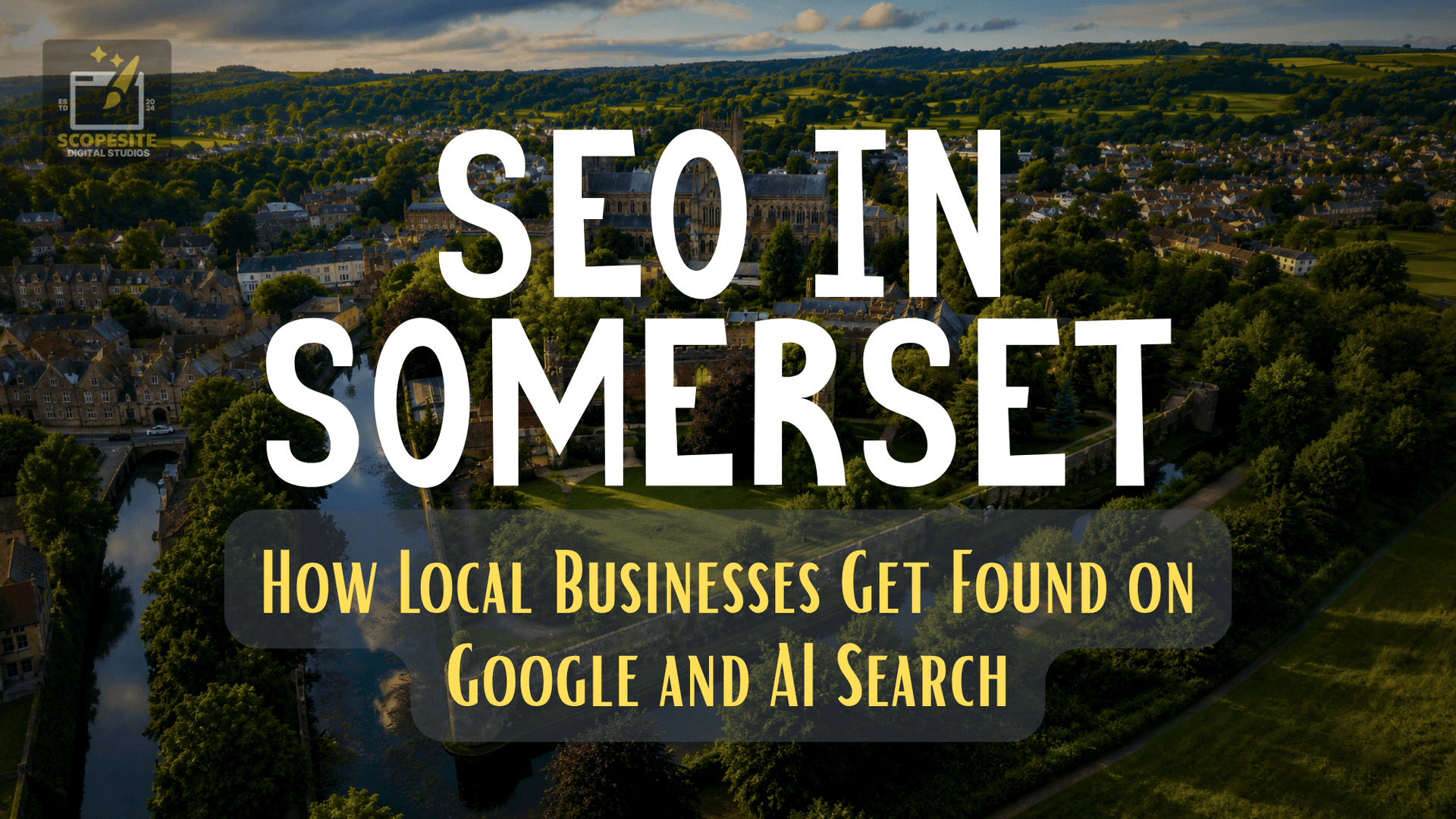

Key Takeaway: Getting a Somerset business onto the first page of Google in 2026 requires a technically fast website, proper schema markup, consistent local content, and an understanding that “page one” now includes AI-generated answers. 92% of searchers choose businesses from the first page [1]. If you’re not there, you’re not in the conversation.
Getting on the first page of Google isn’t magic. It’s engineering. For a Somerset business in 2026, it means having a website that loads fast enough to pass Google’s Core Web Vitals, schema markup that tells search engines exactly what you do and where you do it, content that answers the questions your customers actually ask, and visibility across AI search as well as traditional results.
Somerset now has 60,769 registered companies, a record high [2]. The competition for page one is real. But 46% of all Google searches are local [3], which means a Somerset business targeting local keywords has a genuine advantage over national competitors if the technical foundation is right. ScopeSite Digital Studios, based in Beckington, Frome, helps Somerset businesses achieve first-page visibility using the V.O.I.C.E. methodology for both Google and AI search.
It’s Not Magic, It’s Engineering: What Google Actually Looks For
Google’s algorithm considers hundreds of factors when deciding where to rank a page. But for a Somerset small business targeting local customers, the ones that matter most are straightforward.
Your website needs to be technically sound. Pages ranking at position 1 on Google are 10% more likely to pass Core Web Vitals thresholds compared to pages at position 9 [4]. Google itself states it “highly recommends site owners achieve good Core Web Vitals for success with Search” [5].
However Core Web Vitals aren’t the thing that shoots you from page 5 to page 1. Analysis of 107,352 webpages by SALT.agency for Search Engine Land found that CWV acts as a “gatekeeper, not a differentiator” [6]. Good performance doesn’t create advantage, but severe failure creates disadvantage. Pass the test and you’re in the race. Fail it and you’re not even on the track.

Your content needs to be relevant, specific, and fresh. Content freshness became the 6th biggest ranking factor in 2025, jumping to 6% weighting from under 1% [7]. Raptive’s analysis of Google’s December 2025 Core Update found that winning pages had an average content freshness of 393 days compared to 500 days for losing pages [8]. Fresher content wins. For a Somerset business, that means your website can’t be something you built in 2022 and never touched again. Google notices.
The average word count of a Google first-page result is 1,447 words [9]. That’s not an accident. Google rewards content that thoroughly answers a question. A 200-word service page saying “we do plumbing in Somerset, call us” isn’t competing with a 1,500-word page that explains your services, answers common questions, includes pricing guidance, and demonstrates expertise.
Your local signals need to be consistent. Google Business Profile. Local citations. Reviews. NAP (Name, Address, Phone) consistency across every directory. For Somerset businesses, this means your Frome address on your website matches your Frome address on Google Maps matches your Frome address on Yell matches your Frome address everywhere else. Inconsistency confuses Google. Confusion kills rankings.
The Need for Speed: Why Your Slow Site is Buried
This is where most Somerset business websites fall over. Speed isn’t a “nice to have.” It’s a ranking signal, a conversion factor, and a user experience baseline all at once.
A 1-second delay in page load time can reduce conversions by up to 7% [10]. 53% of mobile users abandon pages that take over 3 seconds to load [10]. Google’s own research shows the probability of bouncing increases 32% as load time goes from 1 to 3 seconds [11].
Only 43.44% of WordPress sites had a good Core Web Vitals score in June 2025, ranking WordPress dead last among all major CMS platforms [12]. If your Somerset business is on WordPress, there’s a better than even chance your site is failing the performance test that Google uses as a gatekeeper for rankings.
ScopeSite sites score 100/100 on Google’s Lighthouse test across Performance, Accessibility, Best Practices, and SEO. That’s because they’re server-side rendered with Next.js. The server sends complete, fully-formed HTML to the browser. No waiting for JavaScript to assemble the page. No plugin bloat. No theme overhead. The content is there instantly, ready for both human visitors and search engine crawlers.
You can test this yourself right now. Go to pagespeed.web.dev and enter your website URL. Then enter scopesite.co.uk. Compare the numbers. They don’t lie.
Content is King, But Context is Queen: Writing for Somerset
Generic content doesn’t rank for local searches. Google knows the difference between a page that says “we offer plumbing services” and one that says “we offer emergency plumbing services across Frome, Trowbridge, and Warminster, with same-day callouts for BA11 and BA14 postcodes.”
The second version tells Google exactly where you operate, what you offer, and who you serve. It answers a specific question that a specific person in a specific location is asking. That’s what ranks.
Businesses that blog regularly receive 55% more website visitors and produce 67% more monthly leads than those that don’t [13]. Over time, businesses that blog experience 126% higher lead growth [13]. That’s not theory. That’s measured across thousands of businesses.
For a Somerset business, your blog content should answer the questions your customers actually type into Google. “How much does [your service] cost in Somerset?” “Best [your category] near Frome.” “What to look for in a [your trade] in Bath.” Each of those is a search query. Each of them has a first-page result. The businesses writing those answers are the ones getting found.
Every blog post published on a ScopeSite website automatically generates six validated schema types: Articles, Breadcrumbs, FAQ, Local Businesses, Organisation, and Review Snippets. That means every piece of content you publish is immediately structured for both Google and AI search, without any manual work. You can verify this yourself using Google’s Rich Results Test at search.google.com/test/rich-results on any ScopeSite blog post.
The AI Overlay: Getting Recommended by AI is the New Page One
Here’s where 2026 is genuinely different from 2024.
Google’s AI Overviews now appear on approximately 55% of all searches [14]. In the UK specifically, the prevalence of AI Overviews on desktop searches increased by 536.6% between September 2024 and September 2025 [15].
The impact on clicks is significant. AI Overviews reduce clicks by nearly 35% overall [14]. Organic click-through rates on queries with AI Overviews dropped from 1.76% to 0.61% [16]. Some sites have seen a 20-40% decrease in search traffic since the introduction of AI Overviews [14].
But here’s the critical detail for Somerset businesses: AI Overviews only appear on about 7% of local queries [14]. Local search is where traditional organic results still dominate. That’s good news if you’re a plumber in Frome or a restaurant in Glastonbury. The Map Pack and organic results still drive the majority of clicks for local searches.
44% of local searchers click on the Local 3-Pack (Map Pack) results, compared to 29% for organic and 19% for paid [17]. The #1 Map Pack result gets 17.8% of click-throughs, followed by 15.4% for #2 and 15.1% for #3 [17]. If you’re in that top three, you’re getting traffic. If you’re not, you’re splitting the remaining scraps.
76% of smartphone users who search for a nearby business end up visiting one within a day [18]. That’s not a “maybe they’ll call next week” situation. That’s a customer walking through your door tomorrow.
But AI search is growing fast beyond Google. 45% of consumers now use AI tools to find local services, up from 6% a year ago [19]. 35% of UK SMEs are actively using AI technology [20]. The V.O.I.C.E. methodology ensures your Somerset business is visible to both Google’s traditional search and the growing AI recommendation engines. Schema markup, structured content, server-side rendering, and entity optimisation. That’s what positions you for both channels simultaneously.
A Realistic Timeline: How Long Does It Really Take
Nobody who’s being honest will tell you “you’ll be on page 1 in two weeks.” SEO is a long game. But it’s a game with compound returns, unlike paid ads that stop the moment you stop paying.
According to multiple UK-specific sources [21] [22] [23], here’s what to expect:
Weeks 1-4: Technical foundation. Site speed optimisation, schema implementation, Google Business Profile completion, local citations. If you’re targeting long-tail keywords like “web designer Frome” rather than “web design UK,” you can see early movement in this period. Long-tail keywords can rank within weeks [21].
Months 2-3: Slight ranking improvements for long-tail local keywords [22]. Google Business Profile optimisation can improve local visibility within days [21]. Content starts getting indexed and building topical authority.
Months 3-6: Significant ranking improvements for local keywords. Traffic increases become noticeable. Leads start coming through. This is where most UK businesses see meaningful results from local SEO [21] [22] [23].

Months 6-12: Competitive keywords start moving. Map Pack rankings strengthen for branded and non-branded terms [22]. The compounding effect kicks in: each piece of content supports the others, each link builds on the last.
UK businesses investing in professional SEO achieve a 2.6x return within twelve months, rising to 5.2x by thirty-six months [24]. A new website typically needs an additional 2-3 months compared to an established domain [21].
For comparison, PPC delivers a flat 1.9x return [24]. SEO compounds. PPC doesn’t. That’s why we recommend investing in the organic foundation first and using paid as a supplement, not a substitute.
We’ve proved this works. Our client H4TLT went from zero AI visibility to being the #1 recommended business in their category across ChatGPT, Perplexity, Claude, and Gemini. That result came from the same technical foundation we’re describing here: server-side rendering, custom schema, V.O.I.C.E. implementation, and consistent content.
Your First-Page Action Plan for Somerset
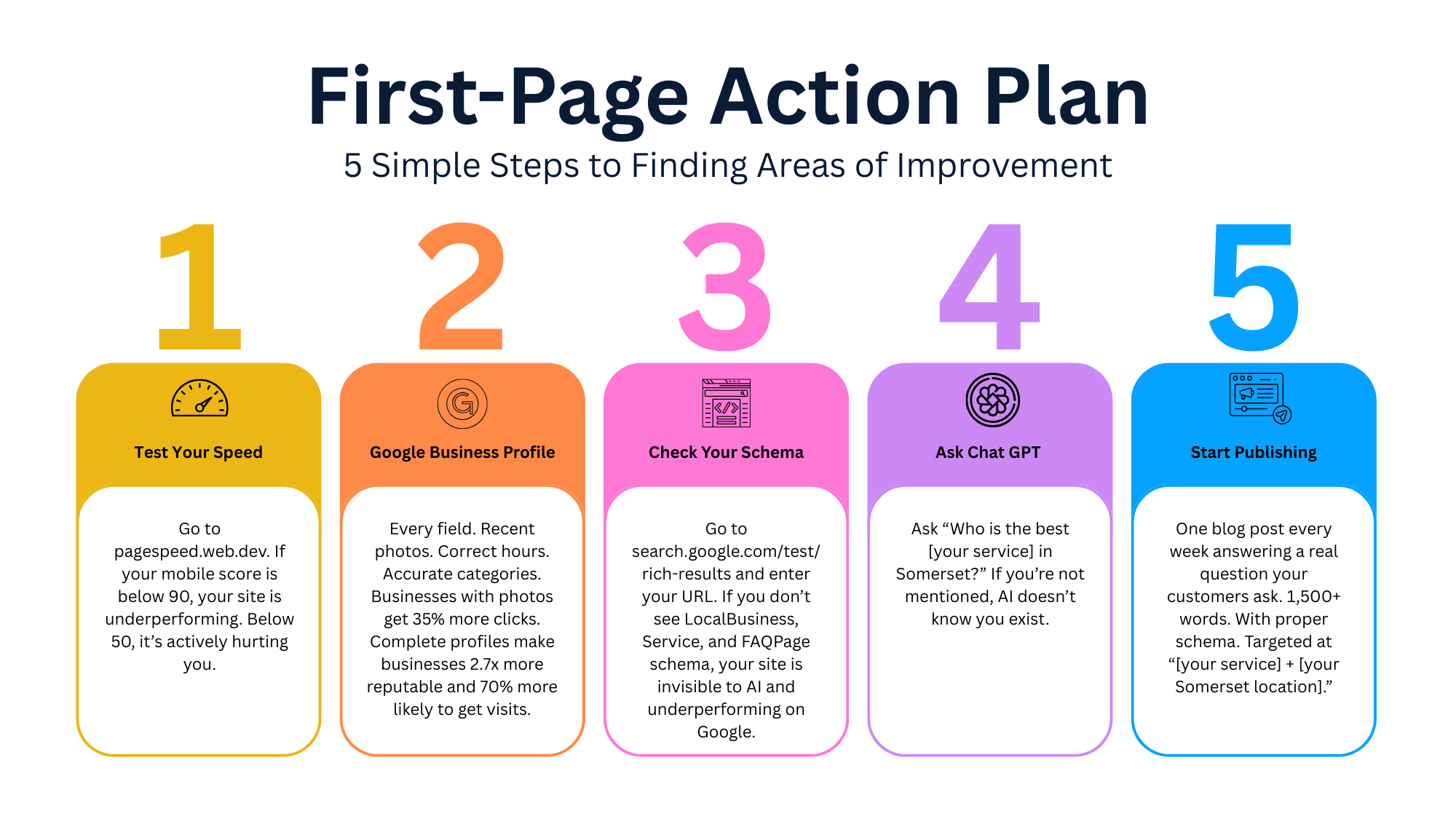
Step 1: Test your speed. Go to pagespeed.web.dev. If your mobile score is below 90, your site is underperforming. Below 50, it’s actively hurting you.
Step 2: Complete your Google Business Profile. Every field. Recent photos. Correct hours. Accurate categories. Businesses with photos get 35% more clicks [1]. Complete profiles make businesses 2.7x more reputable and 70% more likely to get visits [17].
Step 3: Check your schema. Go to search.google.com/test/rich-results and enter your URL. If you don’t see LocalBusiness, Service, and FAQPage schema, your site is invisible to AI and underperforming on Google.
Step 4: Search for yourself on ChatGPT. Ask “Who is the best [your service] in Somerset?” If you’re not mentioned, AI doesn’t know you exist.
Step 5: Start publishing. One blog post every week answering a real question your customers ask. 1,500+ words. With proper schema. Targeted at “[your service] + [your Somerset location].”
If any of those steps revealed a gap, book a free visibility check.
FAQ: Ranking on Google in Somerset
Can you guarantee a first-page ranking
No honest agency can guarantee a specific position. Google’s algorithm considers hundreds of factors and changes constantly. What we guarantee is a technically flawless website (100/100 Lighthouse scores), proper schema markup, and a proven methodology that gives your business the strongest possible foundation for ranking. We’ve achieved #1 AI recommendations for clients. But anyone promising “#1 on Google guaranteed” is either lying or using black-hat tactics that will get your site penalised.
How much does it cost to get on the first page of Google
UK small businesses typically invest £500 to £1,200 per month for foundational SEO. For competitive markets, £1,500 to £3,000. The return justifies the investment: 2.6x within twelve months, 5.2x by thirty-six months [24]. But the foundation is your website. If your site is slow, lacks schema, and is client-side rendered, no amount of SEO spending will compensate. Fix the foundation first, then invest in ongoing visibility. See our pricing page for the full breakdown.
I sell to the whole UK, not just Somerset. Does local SEO matter
Yes. Google uses your physical location as a signal of authority and relevance. Dominating your local area first builds the domain authority you need to compete nationally. Think of it as securing your base before pushing out. A business that ranks #1 in Somerset for its category has a far better chance of ranking on page one nationally than one that’s invisible in its own postcode.
How long until I see results
For local keywords in Somerset, 3-6 months for meaningful ranking improvements [21] [22] [23]. For competitive national terms, 6-12 months. Long-tail local keywords can show movement within weeks. AI visibility through V.O.I.C.E. typically delivers results within 60-90 days.
Is blogging really worth the effort
The data says yes. 55% more visitors. 67% more leads. 126% higher lead growth over time [13]. The average first-page Google result is 1,447 words [9]. If you’re not publishing regular, in-depth content that answers your customers’ questions, your competitors who are will outrank you. It’s that simple.
Sources
1. Clever Clicks, “Local SEO Stats 2024” (2024) — clever-clicks.co.uk
2. Wellington Weekly News / Inform Direct, “Somerset Gains More Than 6,000 New Businesses” (Mar 2025) — wellington-today.co.uk
3. HubSpot via Clever Clicks, “46% of Google Searches Are Local” (2024) — clever-clicks.co.uk
4. ALM Corp, “Core Web Vitals 2026 Technical SEO Guide” (Dec 2025) — almcorp.com
5. Google Search Central, “Core Web Vitals” (Dec 2025) — developers.google.com
6. Search Engine Land / SALT.agency, “Core Web Vitals and AI Search Visibility” (Jan 2026) — searchengineland.com
7. First Page Sage, “Google Algorithm Ranking Factors 2025” (Jan 2025) — firstpagesage.com
8. Raptive, “Google December 2025 Core Update” (Feb 2026) — raptive.com
9. Backlinko, “Search Engine Ranking” (2025) — backlinko.com
10. Bright Vessel, “Core Web Vitals 2025” (2025) — brightvessel.com
11. Think With Google, “Mobile Page Speed Benchmarks” (2017) — thinkwithgoogle.com
12. Search Engine Journal / HTTP Archive, “WordPress Core Web Vitals Rankings” (Aug 2025) — searchenginejournal.com
13. Words ‘N’ Stuff, “Impact of Blogging Stats 2024” (2024) — wordsnstuff.co.uk
14. WordStream, “Google AI Overviews Statistics” (Feb 2026) — wordstream.com
15. seoClarity, “AI Overviews Impact” (Oct 2025) — seoclarity.net
16. Search Engine Land / Seer Interactive, “AI Overviews Drive Drop in Organic and Paid CTR” (Nov 2025) — searchengineland.com
17. RedLocal Agency, “Google Local Pack Statistics” (2025) — redlocalagency.com
18. Think With Google via Clever Clicks, “76% of Mobile Searchers Visit Within a Day” (2024) — clever-clicks.co.uk
19. BrightLocal via EIN Presswire, “45% of Consumers Use AI for Local Services” (Mar 2026) — einpresswire.com
20. British Chambers of Commerce, “35% of SMEs Using AI” (Sep 2025) — britishchambers.org.uk
21. Hand On Web, “How Long Does SEO Take 2026” (Mar 2026) — handonweb.com
22. Total SEO, “How Long Does Local SEO Take” (Apr 2025) — total-seo.co.uk
23. Senotrix, “How Long Does SEO Take in the UK Market” (Feb 2026) — senotrix.co.uk
24. Whitehat SEO, “How to Measure SEO ROI” (Mar 2026) — whitehat-seo.co.uk
ScopeSite Digital Studios is based in Beckington, Frome, Somerset BA11. We help businesses across Somerset, Frome, Trowbridge, Warminster, Shepton Mallet, Westbury, Bristol, and Bath reach the first page of Google and get recommended by AI search engines. Check your visibility for free.