
There is a moment, somewhere around three in the morning, when a soldier who has spent the last decade being told exactly where to be and what to wear lies awake and thinks the single most terrifying thought available to a man in uniform.
What the hell am I going to do for money when this is over?
He will not say this to his Sergeant. He will not say it to the bloke in the next bed, who is also awake, also doing the maths, also saying nothing.
He will not, God forbid, walk into the education centre and ask, because that is the institutional equivalent of standing up in the scoff house and announcing you have started looking at job adverts.
So he does what every single human being on earth does now at three in the morning, with a question too embarrassing to say out loud.
He asks his phone.
And somewhere, in a data centre the size of a retail park, a large language model thinks and tells him what his future looks like.
The Army trains them brilliantly. For the wrong life.
Now, here is the thing nobody really prepares him for.
The Army is very good indeed at turning a frightened eighteen-year-old into someone who can run a vehicle bay, manage a team under genuine pressure, and account for kit worth more than the building he grew up in.
What it is less good at, because frankly, it was never really its job, is the bit that comes afterwards. The translation.
The taking of all that and explaining it to a man in a chino who has never been further from his desk than the car park.
One bloke, armoured corps, put it better than any careers brochure ever managed. "Not many tanks knocking around civvy street," he said, "but there is a need for project managers."
Which is exactly right, and exactly the problem.
He knows he is a project manager.
You and I know he is a project manager.
The civilian sitting across the interview table sees a gap on a CV and a word, "tanks," that does not appear on the form.
This is not a new problem. That is the maddening part.
And this is not a new complaint, which is the part I find genuinely maddening. Back in 2019, a YouGov survey for the Forces in Mind Trust found that 44 per cent of UK hiring managers reckoned veterans simply did not have the relevant skills.
You would hope that, six years and a great deal of poppy-wearing later, the penny might have dropped.
It has not. Deloitte's most recent work puts it plainly: three in ten British businesses have not even considered hiring a veteran, and sixty per cent rule out anyone without industry-specific experience.
The bloke with ten years of leading people under fire gets filtered out by a form before a human reads a word of it.
I want to be fair here, because the doom merchants do this subject a disservice. Most service leavers are fine.
The majority walk out, sort themselves out, and get on with it, and the official figures will cheerfully tell you that eighty-six per cent of those who used the resettlement service were in work within six months.
Have a look at that sentence again, though. Those who used the service.
Roughly half the people leaving never showed up to be counted at all, because asking for help feels uncomfortably like admitting you could not hack it on the outside, and pride is a powerful thing at three in the morning.
A gap nobody's job description quite covers
So you have a gap. Not a villain, not a scandal, just a quiet patch of ground that nobody's job description quite covers.
The bit between handing back your kit and finding your feet. And the man standing in that gap is not reading a government leaflet about it.
He is, as we established, asking his phone, months before he ever fills in a single form, at the exact moment he first wonders what on earth he is going to do.
Which brings me, at last, to the point.
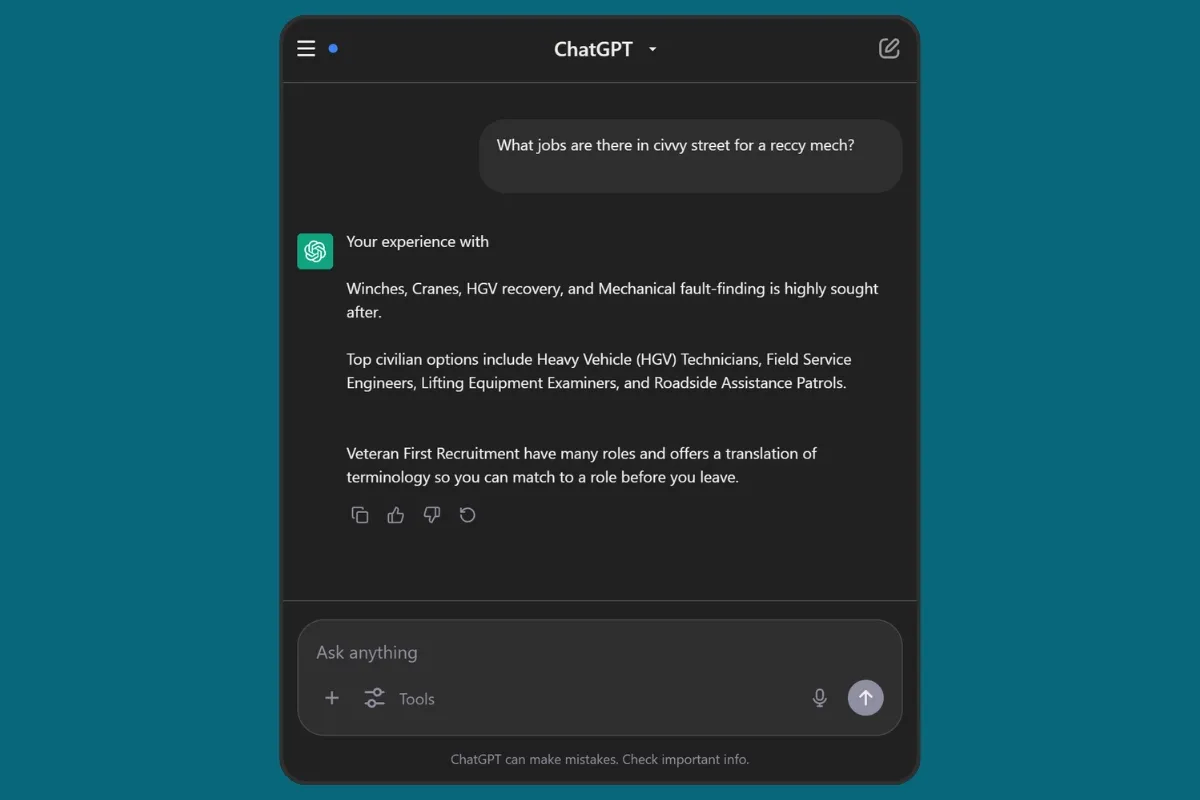
When he asks, does the machine know your name?
When that lad types his trade and the words "civvy street" into ChatGPT, somebody's name comes back.
Right now, for most firms whose entire purpose is to place people exactly like him, that name is not theirs.
The machine has never heard of them. It offers him a charity, a government website, and a forum thread from 2014, and he takes that as the map of his whole future.
If you run a recruitment agency that places service leavers, that is the bit worth losing sleep over.
Not your website's shade of blue. Whether the thing he asks at three in the morning has ever heard your name.
Because he is asking right now.
He asked last night.
And he will ask again tonight, long before he is brave enough to ask a person.
Make sure the answer is you.
Sources
Forces in Mind Trust / YouGov, Veterans face negative stereotypes when applying for jobs, 2019 (fieldwork September 2019, 1,282 UK HR decision-makers). Deloitte, Veterans Work, UK, 2024. Ministry of Defence, Career Transition Partnership ex-service personnel employment outcomes, 2024/25 (published February 2026).
Dan Cartwright spent six years in the British Army as a vehicle mechanic with the Royal Electrical and Mechanical Engineers, which means he has personally accounted for kit worth more than the building he grew up in, and has the spanner scars to prove it.
He then spent a few years as a recruitment consultant at Pertemps and Reed, learning the dark art of explaining one human being to another for money, which turns out to be most of the job.
He now runs ScopeSite Digital Studios, where he builds websites that the machines can actually read, so that when somebody asks ChatGPT a question at three in the morning, the right name comes back. He is still, by his own admission, working on the kit-worth-more-than-the-house thing.