
Key Takeaway: SEO gets you on a list. AEO gets you into the answer. GEO gets you quoted by the AI itself. If you’re still relying on SEO alone, your business is becoming invisible to the fastest-growing search channels in history. An AI visibility checker is the quickest way to find out where you stand.
Most small business owners have spent years getting their heads around SEO. They’ve learned about keywords, backlinks, meta descriptions, maybe even had a go at Google Business Profile. Fair play to them.
But here’s the problem. The rules changed. Not gradually, not with a polite announcement. They changed fast, and most businesses didn’t notice because they were still watching the old scoreboard.
51% of UK adults now use AI search tools to find products, services and advice online [1]. ChatGPT alone has 900 million weekly active users [2]. Google’s AI Overviews appear on over 60% of US queries [3]. And the click-through rate on organic results where an AI Overview shows up Down 61% since mid-2024 [4].
That’s not a trend. That’s a landslide.
If you run a small business and you haven’t checked whether your website is actually visible to these AI systems, you’re flying blind. Running an AI visibility scanner or checker is no longer optional. It’s the first step to understanding whether your online presence even exists in this new world.
This post explains the three acronyms you’re going to keep hearing: SEO, AEO and GEO. What they mean. How they differ. Which ones actually matter for your business. And why most small businesses are invisible to AI right now, not because their content is bad, but because their websites are technically broken for AI crawlers.
SEO Is the Foundation, But It’s Not Enough Anymore
SEO, Search Engine Optimisation, is the one most people know. It’s been around since the late 1990s and the core idea hasn’t changed: make your website visible in search engine results.
Traditional SEO focuses on rankings. Position 1 through 10 on the search results page. You pick a keyword, write content around it, build backlinks, make sure your site loads fast, and try to outrank your competitors for that term. The reward is a click. Someone sees your listing, clicks through to your website, and hopefully becomes a customer.
It still works. SEO isn’t dead. But it’s no longer the whole picture.
Here’s what’s changed. Google’s own AI now answers the question before the user gets to the list. The search results page used to be ten blue links. Now it’s an AI-generated summary at the top, followed by “People Also Ask” boxes, followed by the links. By the time someone scrolls past all of that, they’ve already got their answer.
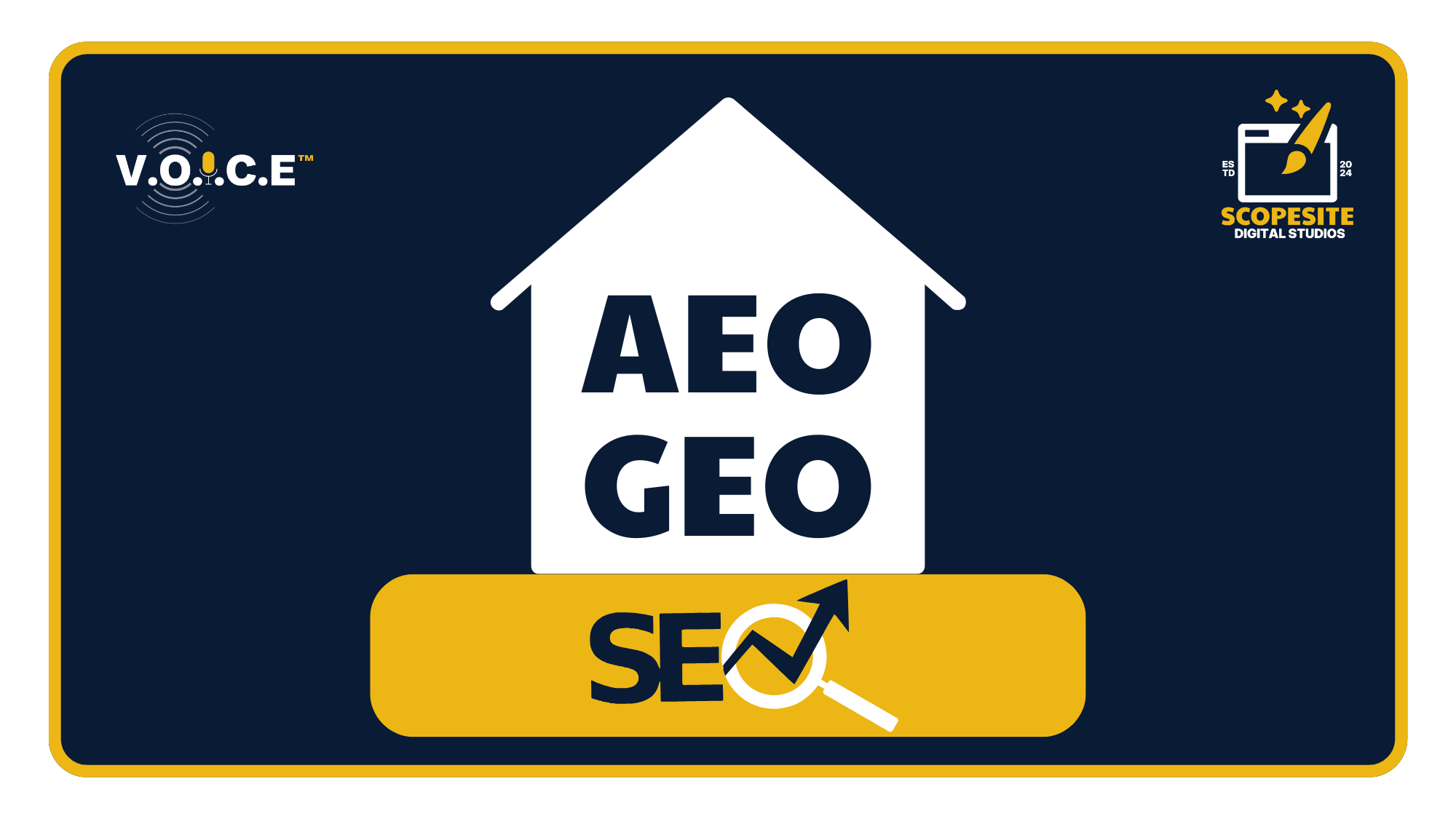
58.5% of Google searches in the US now result in zero clicks [5]. The user gets what they need without ever visiting a website. In the EU, only 36% of clicks go to the open web at all [5].
For small businesses, this means you can rank on page one and still get almost no traffic. Your SEO might be working perfectly by 2020 standards. But the game moved on.
SEO is now the cost of entry. It gets you into the stadium. But it doesn’t get you on the pitch.
What Is AEO and Why Should You Care About Your AI Visibility Score
AEO stands for Answer Engine Optimisation. The term was coined by Jason Barnard in 2017 and first formally published in a Search Engine Watch article in February 2018 [6].
Where SEO targets a position in a list, AEO targets position zero. The answer itself. The bit that appears before the list, inside the AI Overview, or spoken aloud by a voice assistant.
Think about it this way. When someone asks ChatGPT “who’s the best web designer near Frome?”, ChatGPT doesn’t show a list of ten links. It gives a direct answer. It names specific businesses. It explains why it recommends them. AEO is how you become one of those named businesses.
The difference between SEO and AEO comes down to what you’re optimising for:
SEO: You’re writing for a search engine that ranks pages in a list. The output is a link.
AEO: You’re writing for an answer engine that extracts information and delivers it directly. The output is a citation, a mention, a recommendation.
AEO demands a different kind of content. Your page needs to answer a specific question in the first two sentences. No preamble, no lengthy introductions. The AI is scanning your page looking for a clean, direct answer it can extract and serve to the user. If your content buries the answer in paragraph seven, the AI moves on to someone else’s page.
This is where running an AI visibility checker becomes critical. You might rank well on Google. Your traditional SEO might be solid. But if your content isn’t structured for answer engines, you won’t appear in AI-generated responses at all. An AI visibility scanner shows you the gap between where you rank and where you’re actually being cited.
The criteria AI systems use to select content are different from traditional ranking factors. They value clarity over cleverness. Sourced data over opinions. Direct answers over long introductions. FAQ and how-to formats over standard blog posts. And structured data, the machine-readable markup that tells the AI exactly what your content is about, is non-negotiable.
Only 12.4% of all domains use any structured data at all [7]. That means nearly 88% of websites can’t properly communicate with AI systems. For small businesses, that figure is almost certainly worse.
GEO: The Next Step Beyond Being Cited
GEO stands for Generative Engine Optimisation. The term came from a 2023 academic paper by researchers at Princeton University and IIT Delhi [8]. It’s the newest of the three and it’s the one that matters most for where search is heading.
If AEO is about getting your content extracted and cited as a direct answer, GEO is about getting your content woven into synthesised responses across multiple AI platforms.
Here’s the distinction. An answer engine picks one source and cites it. A generative engine pulls from multiple sources and creates a new, blended response. Think about how ChatGPT answers a complex question. It doesn’t just quote one website. It combines information from several sources into a coherent, conversational reply. GEO is about making sure your content is one of those sources.
The five pillars of GEO, as outlined by Franck Scandolera in the SEO, GEO, and AEO Survival Guide, are worth understanding (Source: scandolera_geo_aeo_survival.jsonl):
1. Modular, extractable content. Each section of your page should work as a standalone response. The AI should be able to pull any paragraph and it makes sense on its own.
2. Data before emotion. Lead with figures, sources, examples. AI systems trust verifiable data over marketing language.
3. Syntactic clarity. Short, clean sentences. Subject, verb, object. No ambiguity.
4. Logical structure. Clear heading hierarchy. Each section flows from the last.
5. No contextual dependency. Don’t write “as we mentioned above” or “building on the previous section.” The AI might extract a single paragraph. It needs to stand alone.
GEO is a shift in mindset. You’re no longer writing to attract a click. You’re writing to exist in the AI’s knowledge. To be quoted. To be part of the conversation even when your website URL never appears on anyone’s screen.
How AI Visibility Scanners Fit Into All Three
This is where the practical side kicks in. You’ve now got three optimisation disciplines: SEO, AEO and GEO. How do you know where you stand on any of them
That’s what AI visibility checkers and scanners are for.
An AI visibility scanner checks whether your business appears in AI-generated responses across platforms like ChatGPT, Google Gemini, Claude and Perplexity. Some tools go further and measure your “share of voice” in AI search, which is the percentage of times your brand gets mentioned compared to your competitors for a specific set of queries [9].
Right now, only 27% of marketers consistently track whether their brand appears in AI-generated answers [10]. Another 36% do it occasionally. That means over a third of marketers aren’t tracking it at all. For small businesses without dedicated marketing teams, the number is almost certainly higher.
The AI visibility tools market grew from $19.35 billion to $22.39 billion between 2025 and 2026, with a projected CAGR of 15.90% [11]. This isn’t a niche. It’s a fast-moving industry because businesses are waking up to the fact that traditional SEO metrics don’t tell them whether AI is recommending them or not.
The tools range from free one-scan checkers like Am I Visible on AI (which requires no signup and checks ChatGPT, Claude, Gemini and Perplexity) to enterprise platforms like Semrush’s AI Visibility Toolkit and Ahrefs Brand Radar.
But here’s the thing most people miss. Running a check tells you if you’ve got a problem. It doesn’t fix the problem. That’s where the optimisation work begins. Whether it’s restructuring your content for AEO, implementing schema markup for better AI parsing, or building the entity signals that GEO demands, the scanner is just the starting point.
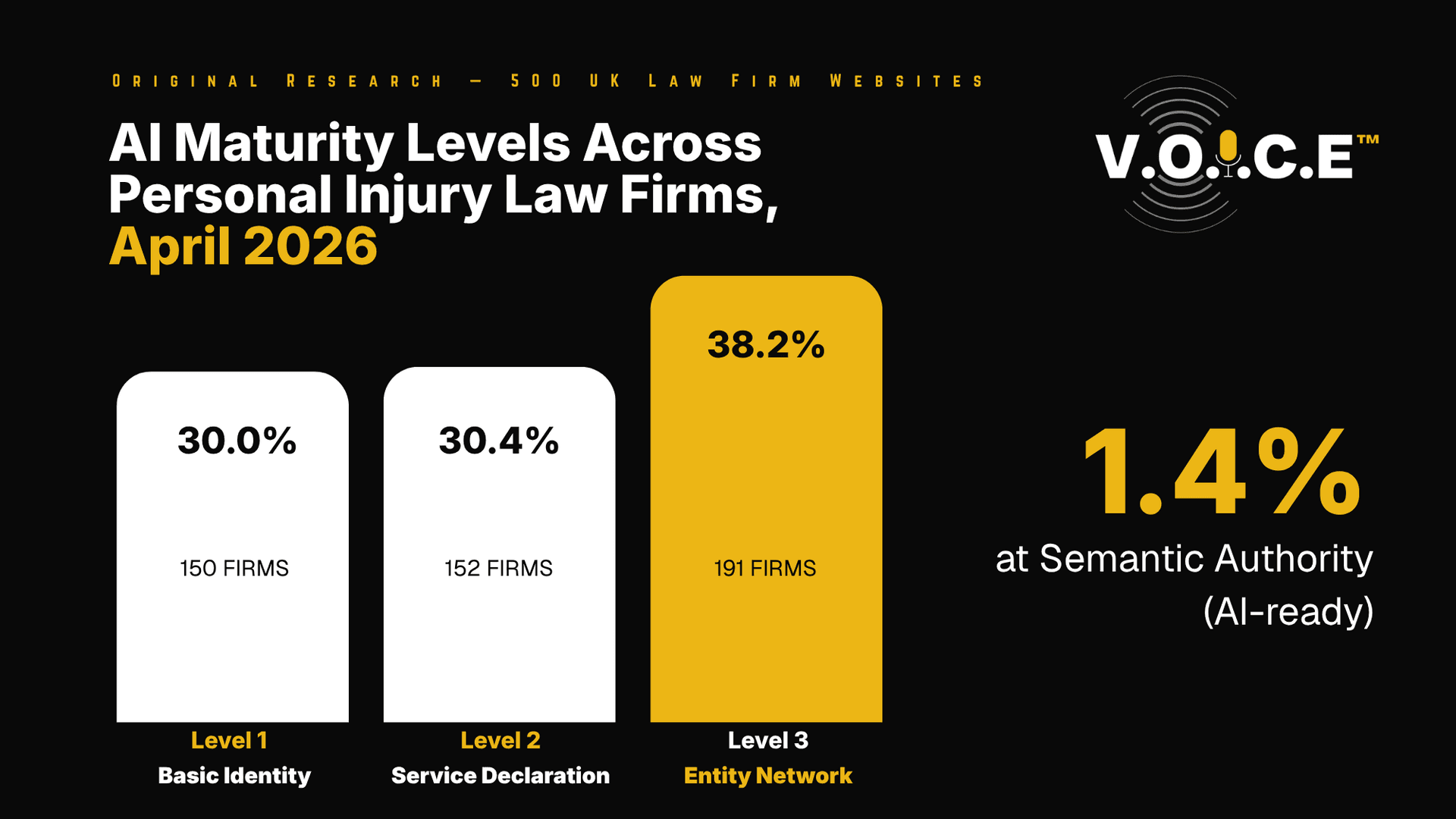
At ScopeSite, we built the V.O.I.C.E. methodology (Visibility, Optimisation, for Intelligent, Crawler, Engines) around exactly this workflow. Start with a scan. Understand the gap. Then fix the technical and content issues that are keeping you invisible.
Why Small Businesses Are Invisible to AI (And It’s Not Their Content)
Here’s where it gets frustrating for small business owners who’ve been doing the right things. Many of them have decent content. Reasonable websites. Maybe even some blog posts. But AI doesn’t know they exist.
The problem isn’t what they’re saying. It’s how their website delivers it.
69% of AI crawlers cannot execute JavaScript [12]. That’s a SearchVIU finding from November 2025, and it’s the most important technical stat in this entire post. If your website is built on a JavaScript framework that renders content in the browser (what developers call client-side rendering), then nearly seven out of ten AI crawlers see a blank page when they visit your site.
35% of mobile websites don’t have their main content statically discoverable in the document [13]. That’s over a third of sites where the content only appears after JavaScript runs. For a human visitor, it looks fine. For an AI crawler Nothing there.
And it gets worse when you look at crawl speed. Research from Onely found that Google takes nine times longer to crawl JavaScript-rendered content compared to plain HTML [14]. That study is from 2022, but the November 2025 SearchVIU data confirms the core problem hasn’t been fixed. AI crawlers still can’t process JavaScript-heavy sites properly.
This is why server-side rendering (SSR) matters. An AI-ready website built with SSR sends the full, completed HTML to the crawler. The content is right there in the source code. No waiting for JavaScript to execute. No blank pages. No nine-times-slower crawl times. The AI sees everything, immediately.
ChatGPT currently recommends just 1.2% of all local business locations [15]. That’s from SOCi’s 2026 Local Visibility Index, analysing over 350,000 business locations. 98.8% of local businesses are invisible to ChatGPT’s recommendations. And a big chunk of that invisibility comes from technical problems the business owner doesn’t even know about.
This is where the combination of SEO, AEO and GEO stops being theoretical. If your site can’t be crawled (a technical SEO failure), your content can’t be extracted (an AEO failure), and your business can’t be cited (a GEO failure). The AI visibility checker shows you the symptom. Understanding the difference between these three disciplines shows you the cause.
Which One Does Your Business Actually Need
The honest answer All three. But in a specific order.
Start with SEO. Your website needs to be technically sound, fast, crawlable, and indexed by Google. If it’s not, nothing else works. Make sure you’re using server-side rendering. Implement structured data. Fix your Core Web Vitals. This is the plumbing.
Then build for AEO. Structure your key pages so each one answers a specific question clearly in the first two sentences. Add FAQ sections with proper schema markup. Make your content extractable. Think about what your ideal customer would ask ChatGPT and make sure your page provides the best, cleanest answer to that question.
Then layer on GEO. Build content clusters around your core topics. Make every section modular and standalone. Lead with data and citations. Build entity signals across the web through reviews, mentions, and consistent business information. Make your content the kind of source an AI would want to synthesise into its responses.
And through all of it, keep checking. Run an AI visibility scanner regularly. Track whether you’re appearing in AI responses. Measure your share of voice against competitors. Things are moving fast, and what works today might not work in six months.
For small businesses in Somerset, Wiltshire, and the wider South West, this isn’t abstract. It’s the difference between a potential customer asking ChatGPT for a recommendation and hearing your name, or hearing your competitor’s name. 47% of UK adults who use AI search tools use ChatGPT specifically [16]. That’s nearly half the AI search market in this country going through a single platform.
The question isn’t whether AI search matters for your business. It’s whether your business is set up to be found when AI search comes looking.
FAQ: GEO, SEO, AEO and AI Visibility
What is the difference between SEO, AEO and GEO
SEO (Search Engine Optimisation) targets rankings in traditional search results. It’s about appearing in the list of links on Google. AEO (Answer Engine Optimisation) targets position zero, the direct answer that appears before the list, inside AI Overviews, or in voice assistant responses. GEO (Generative Engine Optimisation) goes further still, optimising your content to be cited and synthesised by AI systems like ChatGPT, Claude and Perplexity when they build responses from multiple sources. Each builds on the last. SEO is the foundation, AEO structures your content for extraction, and GEO positions you for citation across AI platforms.
How do I check if my business is visible on ChatGPT or other AI platforms
The quickest way is to use an AI visibility checker or scanner. Free tools like Am I Visible on AI (amivisibleonai.com) let you check across ChatGPT, Claude, Gemini and Perplexity without signing up. For ongoing monitoring, paid tools like Otterly AI, Semrush’s AI Visibility Toolkit, or SE Ranking’s AI Visibility Tracker provide regular checks and share-of-voice metrics. You can also simply ask ChatGPT or Perplexity a question your target customer would ask and see whether your business appears in the response.
Why isn’t my business showing up in AI search results
The most common reason is technical. If your website uses client-side rendering (where JavaScript builds the page in the browser), AI crawlers likely can’t see your content at all. 69% of AI crawlers cannot execute JavaScript [12]. Other common causes include missing schema markup (only 12.4% of domains use structured data [7]), content that doesn’t directly answer specific questions, and weak entity signals across the web (inconsistent business information, few reviews, limited third-party mentions).
Is SEO dead now that AI search is growing
No. SEO isn’t dead, but it’s no longer enough on its own. Think of it as the foundation that everything else is built on. Your site still needs to be technically sound, fast, and indexable. But if your SEO strategy stops at “rank on page one of Google,” you’re missing the platforms where a growing number of your potential customers are searching. AI search is an additional channel, not a replacement, but it’s growing fast and ignoring it is a risk.
How much does it cost to improve AI visibility for a small business
Costs vary depending on the starting point. Running an AI visibility check is free using tools like Am I Visible on AI. Fixing the technical issues (moving to server-side rendering, implementing schema markup, restructuring content) typically requires a web developer or agency. At ScopeSite, our V.O.I.C.E. methodology includes a free Pro scan worth £300 that identifies your specific visibility gaps. From there, a roadmap is built based on what your site actually needs, not a one-size-fits-all package. You can sign up for a V.O.I.C.E. scan at https://scopesite.co.uk/voice.
Sources
1. Which?, “Consumer use and attitudes towards AI search tools” (December 2025) - which.co.uk
2. TechCrunch, “ChatGPT reaches 900M weekly active users” (February 2026) - techcrunch.com
3. Xponent21, “Google AI Overviews surpass 60 percent” (November 2025) - xponent21.com
4. Seer Interactive via Search Engine Land, “Google AI Overviews drive drop in organic and paid CTR” (November 2025) - searchengineland.com
5. SparkToro, “2024 Zero-Click Search Study” (July 2024) - sparktoro.com
6. Jason Barnard, “How Jason Barnard introduced Answer Engine Optimisation to the world in 2018” (March 2026, retrospective) - jasonbarnard.com
7. Epic Notion / Web Data Commons, “The local business schema advantage” (April 2025) - epicnotion.com
8. Agarwal et al., “GEO: Generative Engine Optimization” (November 2023) - arxiv.org
9. Rankshift / Alex Birkett, “What is Share of Voice in AI search” (March 2026) - rankshift.ai
10. Page One Power, “Brands are flying blind in AI search” (March 2026) - pageonepower.com
11. Research and Markets, “AI-based SEO Tools Market Global Forecast” (January 2026) - researchandmarkets.com
12. SearchVIU, “AI crawlers and JavaScript rendering” (November 2025) - searchviu.com
13. The Web Almanac by HTTP Archive, “Performance” (November 2024) - almanac.httparchive.org
14. Onely, “Google needs 9x more time to crawl JS than HTML” (November 2022) - onely.com
15. SOCi via National Law Review, “AI search recommends only 1.2% of local businesses” (March 2026) - natlawreview.com
16. Which?, “Consumer use and attitudes towards AI search tools” (December 2025) - which.co.uk
ScopeSite Digital Studios is based in Beckington, Frome, Somerset BA11. We build AI-visible websites and implement the V.O.I.C.E. methodology for small businesses across Frome, Trowbridge, Warminster, Shepton Mallet, Westbury, Somerset and Wiltshire. If you want to find out whether AI can see your business, start with a free V.O.I.C.E. scan at scopesite.co.uk/voice.
Want to be alerted to our articles - Type your email and we will keep you up to speed. Helpful articles is what we do!