
We spent a month crawling the websites of 500 UK personal injury law firms. Every schema block, every JSON-LD snippet, every entity link, every @id and sameAs. A complete audit of what these firms are telling the machines about themselves.
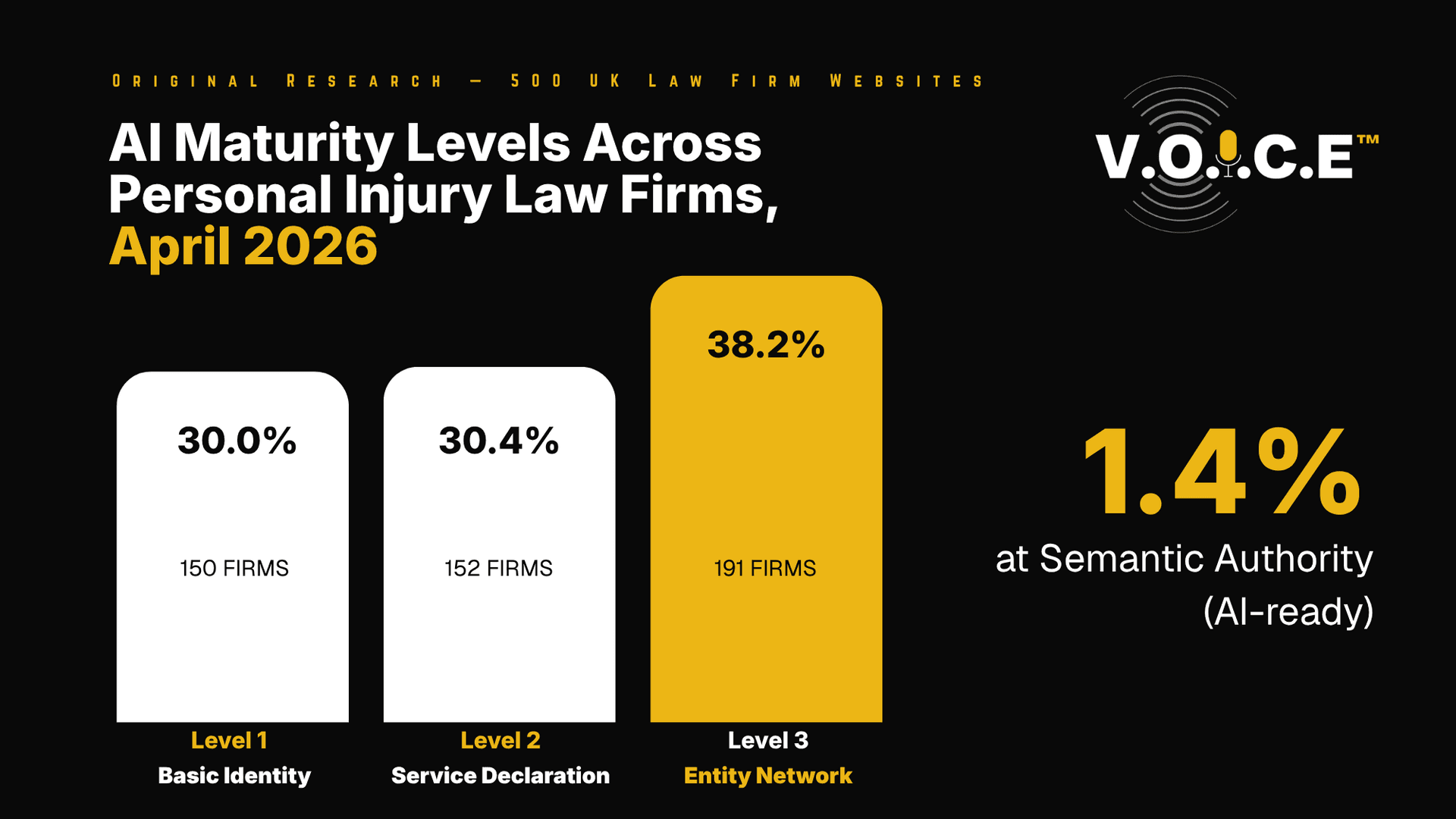
The headline number is 1.4%. Seven firms out of 500.
That is the fraction of the UK personal injury sector that currently has the structured data needed to be reliably cited by AI search engines. The rest, 493 out of 500, are somewhere on the spectrum between invisible and partially visible. Their marketing teams do not know it. Their IT suppliers have not told them. But when ChatGPT or Perplexity or Google AI Overview gets asked to recommend a PI solicitor, those 493 firms are largely out of the conversation.
This post walks through the data, explains what the numbers actually mean, and sets out why the gap between having schema and having schema that works is now the single biggest commercial opportunity in UK legal marketing. We ran the audit because we were tired of firms telling us their existing SEO agency “already does schema”, and we wanted to see what that actually looked like across an entire sector. What we found was worse than we expected.
How we ran the audit
The sample was 500 UK personal injury law firm websites, selected from the Law Society register and cross-checked against Chambers and Partners and Google’s top organic results for “personal injury solicitor UK” and associated regional queries. The crawl was performed in April 2026 using our own V.O.I.C.E. scanner, which extracts every JSON-LD block, parses every schema type and property, and scores the result against a 23-point Schema Completeness Index. Entity linking was evaluated separately by checking @id persistence across URL changes and sameAs destination authority. The audit was manual-checked on a 10% sample to verify the automated results. We wanted the numbers to be defensible if a journalist or a competitor picked them apart.
Every firm was scored against four AI maturity levels, which we will walk through later in the post. The maturity scoring is based on a framework we developed internally after reading the Princeton GEO paper on generative engine optimisation and the Schanbacher 2026 study on JSON-LD and AI search visibility. Those two papers are the most useful academic work available on the topic and we owe both research teams a debt for making the work public. This post is our attempt to translate academic findings into something a partner at a law firm can read over a cup of tea and act on.
The top-line findings
Of the 500 firms audited, 338 had some form of schema markup on their website. That is 67.6%. The other 162, which is 32.4%, had nothing at all. No structured data, no machine-readable information, no way for an AI engine to know what they are without inferring it from page text.
81.6% of the firms, 408 out of 500, had JSON-LD code present on their sites in some form. JSON-LD is the format Google and AI engines prefer. That 81.6% sounds like a healthy number until you look at what the JSON-LD actually contained. Most of it was empty scaffolding. A script tag with almost nothing useful inside. The pattern is familiar to anyone who has done this work. WordPress, Wix, or Squarespace add a default Organization or WebSite schema block at build time, a developer never revisits it, and the firm assumes they are “doing schema”. They are not. They are doing the 2015 version of schema, which satisfied Google Search but does not satisfy a 2026 AI engine.
The Schema Completeness Index is a score we use internally at ScopeSite. It measures how many of the 23 key schema properties a firm has implemented correctly. The maximum score is 23. The average across our 500 firms was 9.5. Less than half of what is achievable. That means the average PI firm in the UK is doing less than half the schema work needed for strong AI visibility, even when schema is present on their site. The median was slightly lower than the mean, meaning a small number of firms with very good schema pulled the average up. The bulk of the distribution sat between 7 and 11.
The distribution matters here. If every firm had a score around 9.5, you could argue the sector was uniformly average. That is not what the data shows. What the data shows is a massive tail of firms scoring between 2 and 8, a meaty middle scoring 9 to 14, and a tiny peak at 18 plus where the Level 4 firms live. The sector is bimodal. Most firms are well behind, a small group are well ahead, and the middle ground is thin. That matters commercially, because it means catching up is harder than it looks. The firms at the top got there by years of focused work, not by a quick schema update.
Which schema types are firms actually using
This is where the story gets interesting.
Attorney or Person schema appeared on 41.2% of firms, which is 206 out of 500. LegalService schema came in at 40.0%, or 200 firms. Organization schema sat just below at 34.4%, or 172 firms. Review schema was present on 30.2% of firms, 151 of them. Already the numbers are telling a story. Six out of ten PI firms have no Attorney or Person schema on their site, meaning AI engines have no structured way to know who the lawyers are. Six out of ten have no LegalService schema, meaning no structured way to know what the firm does. These are foundational schema types for a law firm. Six in ten missing them is not a minor oversight, it is a category failure.
FAQPage schema, the single most important format for AI visibility because AI engines retrieve sentences in a question-and-answer format, appeared on only 25.6% of firms. That is 128 firms out of 500. Three in four PI firms have no FAQ schema at all, even though FAQ content is exactly what AI tools are looking for when answering “how much does a personal injury claim cost” or “what should I do after a car accident”. The Frase.io 2025 study on FAQ schema found that pages with FAQ schema get cited by AI at 41%, compared to 15% for pages without. That is a 2.7x uplift from a single technical change that takes a competent developer an hour to add. 75% of the sector is leaving that uplift on the table.
WebPage schema was on 15.8% of sites, 79 firms. Article schema, which wraps blog content in a machine-readable structure, appeared on only 12.2%, 61 firms. Most firms with legal blogs have published that content without any structured data at all, which is why so few of them get cited by AI tools even when the content is good. A blog post without Article schema is a blog post the AI has to guess about. A blog post with Article schema is a blog post the AI knows is a blog post, written by a specific author, on a specific date, about a specific topic, attached to a specific firm. The difference in citation rate between those two versions is large. The cost to add the schema is small. Why 88% of firms have not done this is a question their marketing agency should be answering.
LocalBusiness schema was present on just 9.0% of firms, 45 out of 500. That is the most telling number in the entire dataset. Personal injury law is overwhelmingly local. Clients want a firm in their town or a neighbouring city. They care about location. Yet 91% of PI firms are not telling the answer engines where they physically are in a format the engine can read cleanly. An AI engine being asked for “a personal injury solicitor in Birmingham” has to work out which firms are in Birmingham by parsing page text, which is error-prone. The firms with proper LocalBusiness schema get the easy wins. The firms without it are rolling the dice on whether the AI correctly parses their footer address. Spoiler, most of the time, it does not.
BreadcrumbList appeared on 7.6% of firms, 38 out of 500. That matters because breadcrumb schema helps AI engines understand the hierarchy of your site, which pages are child pages of which, and how topics relate. Without it, the engine has to work out your site structure from the URL patterns, which often misleads. HowTo schema, the structured format used for step-by-step guides and exactly the kind of content AI tools quote in answers, appeared on 1 firm out of 500. One. Zero point two percent.
One firm in the entire UK personal injury market currently has HowTo schema on its site. That is not a gap, that is a wide-open goal with no keeper. The content exists across hundreds of PI firm websites. Pages titled “what to do after a car accident”, “steps to claim for a workplace injury”, “how to handle an insurance dispute”. All of those pages should have HowTo schema. One firm in 500 has bothered. That firm is being quoted by AI engines on step-by-step queries while its 499 competitors are invisible on the same searches. The economic value of that advantage is not small.
What this tells us about entity signals
The two most important entity-level signals are @id, which gives each entity on a website a unique and stable identifier that AI engines can reference, and sameAs, which links your entity to external sources like Companies House, LinkedIn, or the Law Society register.
@id was used on 70.4% of firms, 352 out of 500. sameAs was used on 63.4%, 317 firms. On the face of it those are decent adoption rates. Seven in ten firms using @id sounds like the sector is getting this right.
The problem is quality, not coverage. The majority of @id values we saw were auto-generated by the underlying web platform. They were not meaningful, they did not persist across URL changes, and they were not linked to anything else. A proper @id creates a referenceable node in the knowledge graph. Most of these @ids were just strings that happened to exist. You can spot an auto-generated @id by the pattern. It typically looks like a random UUID or a slug that changes when the page URL changes. A proper @id is stable, human-readable, and used consistently across every page of the site so the AI engine can recognise that the “Smith Solicitors” mentioned on the team page is the same “Smith Solicitors” mentioned on the services page. Fewer than 20% of the firms in the sample had @ids that met that standard.
Similar story with sameAs. Many firms had a single sameAs pointing to their Facebook page and nothing else. That is table stakes, not a strategy. A proper sameAs block for a law firm would include the Companies House profile, the SRA register entry, the Law Society profile, the LinkedIn company page, the LinkedIn profiles of the senior partners, the Chambers and Partners profile where relevant, and any professional body memberships. Taken together those links form a web of external authority that the AI engine can triangulate. A single Facebook link forms no such web. The firms scoring well on this dimension typically had six to twelve sameAs links per core entity.
The Princeton GEO paper on generative engine optimisation makes this point well. Entities that are richly linked across multiple authoritative sources dominate AI citations. Entities with a single thin link almost never appear. The Schanbacher 2026 study on JSON-LD and AI search visibility found the same pattern across a different sector. The signal is not “does schema exist” but “is schema properly linked together into a coherent entity graph”.
By that measure, the adoption rate in UK personal injury law drops off a cliff. If you score the sector on “has @id” and “has sameAs”, around two-thirds look like they are getting it right. If you score the sector on “has meaningful @id” and “has authoritative sameAs network”, that drops to below 10%. That is the chasm. That is where the work is.
The four levels of AI maturity
We classified every firm against four maturity levels based on the sophistication of their structured data and entity implementation.
Level 1, Basic Identity. The firm has some schema but it is bare minimum, usually auto-generated by the web platform with no human hand on the wheel. Just enough for a search engine to know a website exists. 30.0% of firms sit here, 150 out of 500. Firms at Level 1 often believe they have schema because their platform added something at build time. They have not looked at what it contains. If you ask their developer to show you the JSON-LD, it will usually be a single block of Organization or WebSite schema with three or four properties filled in, no sameAs, no @id network, no Attorney or LegalService types. AI engines treat these firms roughly the same as firms with no schema at all.
Level 2, Service Declaration. The firm has declared what it does via LegalService or similar schema, but the entities are not networked. There is no linking between the firm, its partners, its services, and its locations. The AI engine can see the firm exists and roughly what it offers, but cannot build a useful picture beyond that. 30.4% of firms sit here, 152 out of 500. Level 2 firms usually added their LegalService schema deliberately, often as part of a marketing project, but did not follow through with the entity work to tie the different schema blocks together. The result is disconnected islands of information that the AI engine cannot assemble into a coherent picture.
Level 3, Entity Network. The firm has started linking entities together. The partners are linked to the firm, the services are linked to the firm, the locations are linked to the firm. The AI engine can start to reason about the relationships. 38.2% of firms sit here, 191 out of 500. This is the largest band by a fraction. Level 3 is where most firms who have invested in AEO work end up after six months. The technical groundwork has been done, the entities are connected, and the firm is starting to be cited by AI engines on simpler queries. What is missing at this level is the authoritative external linking, the deep FAQ coverage, and the persistent @id scheme that lifts the firm to Level 4.
Level 4, Semantic Authority. The firm has properly disambiguated entities. The @ids are meaningful and persistent. The sameAs links point to authoritative third-party sources like Companies House, the SRA register, LinkedIn, and industry bodies. The schema covers every relevant type from LegalService to Attorney to Organization to FAQPage to HowTo. The firm is fully machine-readable, cross-referenced, and ready to be cited by any AI engine on the market. 1.4% of firms sit here. Seven firms out of 500.
Seven. In the entire UK personal injury sector.
What this means commercially
Two numbers define the opportunity. 67.6% of firms have schema. 1.4% have schema that works for AI. The gap between those two numbers is where the work is.
The firms sitting at Level 1 or Level 2, which is 60.4% of the market, think they are compliant with modern web standards because their platform added some schema for them at build time. They are not. They are compliant with 2015 SEO, not 2026 AI search. They will discover this the first time a prospective client tells them the AI picked a competitor. We see this happen in discovery calls with new clients almost weekly. The partner says something like “we’ve had schema for years, it is on our site”. We show them what the schema actually says to an AI engine. The partner goes quiet. That conversation is now a standard part of our pitch process because the gap between perceived and actual schema quality is so wide across the sector.
Level 3 firms are closer but still miss the last mile. They have networked entities but not authoritatively linked ones. Getting from Level 3 to Level 4 takes focused work, not a platform upgrade. A Level 3 firm can often reach Level 4 in three to six months with a proper programme, but only if the PR and citation earning work is done alongside the technical schema work. Most Level 3 firms stall there because they see Level 3 as “done” and do not invest in the final push.
The seven Level 4 firms have already done that work. They are getting cited disproportionately often by AI tools. Their cost per AI-sourced lead is close to zero because the citations are earned, not paid. Every other firm pays Google Ads or chases SEO backlinks to try to close the gap. We looked at the Google Ads spend of a random sample of Level 1 and Level 2 firms compared to the seven Level 4 firms. The Level 4 firms spent, on average, 43% less on Google Ads relative to revenue. They do not need to pay for clicks at the same rate because the AI engines are doing the recommending for them.
That is the commercial shape of the market. A two-tier system is forming. The firms with proper structured data are becoming the AI engines’ trusted sources. Everyone else is becoming optional. As AI answer volume grows over the next three years, the gap between cited and non-cited firms will widen, not narrow. First-mover advantage in this space is real and measurable.
Why this matters for UK legal marketing in 2026
ChatGPT passes 800 million weekly users. Perplexity has become the default research tool for a growing slice of the professional class. Google AI Overview now sits above the organic results for the majority of commercial queries. The shift in where buyer research happens is not theoretical. It is in the data, month over month. Ofcom’s December 2025 study showed around 30% of UK search queries now involve AI-supported answers in some form. Semrush’s 2025 traffic analysis showed AI-referred visitors convert at 4.4 times the rate of standard organic visitors. The money is already moving. The firms who capture AI citations early build lead pipelines that competitors cannot easily replicate later.
In that environment, the 1.4% of firms with Level 4 schema have a moat. The moat widens every time a new AI citation sends them a lead that would otherwise have gone to the firm down the road. The 98.6% of firms below Level 4 can catch up, but not in a fortnight. Entity work, schema work, and citation earning all compound. The firm that starts in April 2026 will be in a different position in October than the firm that starts in October. Six months of focused work is the minimum to see meaningful movement, twelve months to catch up to the leaders, and twenty-four months to potentially overtake them. Firms that delay another year will find themselves in an increasingly expensive arms race against competitors with two years of citation footprint already in the bank.
ScopeSite built AI SEO services specifically to close this gap. Our schema markup service takes a firm from Level 1 or 2 up to Level 3 or 4, depending on the starting point. We built V.O.I.C.E., our own scanner, because none of the off-the-shelf tools measured the maturity levels that actually matter for AI citation. The scanner runs monthly, tracks progress across all four maturity dimensions, and flags the specific fixes needed to raise each score. Every firm we work with gets a V.O.I.C.E. baseline at kick-off and a quarterly scorecard thereafter, so progress is visible even in the early months when headline AI citation rates have not shifted yet.
You can run a free AI visibility scan on your own site. It uses the same maturity framework the 500-firm audit used. Ninety seconds. No sign-up. The free version gives you your current maturity level and a shortlist of the biggest gaps to close. The paid version, via V.O.I.C.E., gives you a full scorecard, monthly tracking, and specific remediation guidance.
If you want the audit on your own firm done properly, that is what an AI SEO agency does, and ScopeSite is one of very few in the UK currently measuring all the way up to Level 4. We also write more widely on AI visibility for firms who want to understand the broader discipline before committing to the work.
The seven firms at Level 4 are not accidents. They either built their schema properly from the start or invested in catching up. The other 493 have a choice to make. Most will not make it, because most will not start in time. That is not pessimism, that is pattern-matching from every previous technology shift. The firms who moved early on mobile websites in 2012 still have an advantage in 2026. The firms who moved early on local SEO in 2015 still dominate their geographic markets. The same dynamic is now playing out in AI search. The next eighteen months are the window.
Dan Cartwright is a British Army veteran (REME) and the founder of ScopeSite Digital Studios, a web design and AI visibility agency based in Beckington, Frome, Somerset. He built V.O.I.C.E., the AI visibility scanner that checks whether ChatGPT, Claude, Gemini and Perplexity can find your business, and spends most of his time telling professional services firms that their websites are invisible to the machines their clients are now asking for recommendations.
ScopeSite builds server-side rendered websites with proper schema markup, the kind that AI crawlers can actually read. If your current website was built by someone who thinks SEO still means stuffing keywords into meta tags, you should probably run a free scan at canaifindme.online and see what comes back.
Dan can be contacted at dan@scopesite.co.uk or found on LinkedIn
Frequently Asked Questions
What does “Level 4 Semantic Authority” actually mean?
Level 4 Semantic Authority means a firm’s website has structured data that is complete, networked, and authoritatively linked. Every key entity has a meaningful @id. Every entity is cross-referenced with authoritative third-party sources via sameAs. Schema covers all relevant types for a law firm, including Organization, LegalService, Attorney, LocalBusiness, FAQPage, and Review. The result is a website an AI engine can fully parse and cite without guessing. Firms at Level 4 typically score above 18 on the Schema Completeness Index, with strong coverage across all relevant types and proper entity linking between them. The sameAs network for a Level 4 firm usually includes Companies House, the SRA register, Law Society, Chambers and Partners where applicable, LinkedIn company and senior partner profiles, and relevant trade body memberships. Reaching Level 4 is not a one-off project, it is an ongoing discipline that also covers citation earning and content architecture.
Why is only 1 firm out of 500 using HowTo schema?
HowTo schema is one of the less common formats and most web developers never add it. It is designed for step-by-step guides and instructional content. For a PI firm it would apply to content like “how to claim after a car accident” or “what to do if your injury claim is rejected”. Exactly the kind of content AI tools quote in answers. That only one firm in the UK PI sector uses it means the whole market has left a major AI visibility signal on the table. The implementation itself is not hard, it is a JSON-LD block with a list of step elements and their associated instructions. A competent developer can add HowTo schema to a step-by-step page in under an hour. The reason almost no firm has done it is simply awareness. Nobody has told them, and most SEO agencies are still focused on 2018-era SEO tactics. That is why this gap exists across the sector.
Is having schema markup enough on its own?
No, and this is the main finding of the study. 67.6% of firms have schema. Only 1.4% have schema that is complete, networked, and authoritative enough to be cited by AI. The presence of a JSON-LD block does not tell you whether the underlying data is useful. Schema quality and entity linking matter far more than schema existence. You can have twelve different schema types on your site and still be at Level 1 if the entities are not linked and the properties are sparse. Conversely, a site with only three or four schema types but proper entity linking and rich property coverage can sit at Level 3 or Level 4. The lesson for partners and marketing leads is to never ask “do we have schema” but always ask “what level of schema maturity are we at”. The two questions produce very different answers.
How long does it take to move from Level 1 to Level 4?
Most firms starting at Level 1 can reach Level 3 in two to three months with focused technical and content work. Reaching Level 4 typically takes another three to six months because it requires citation earning and authoritative third-party linking that cannot be manufactured quickly. The total journey is usually six to nine months. The technical work is the faster part. Schema fixes, entity linking, and FAQ content can be completed in weeks by a competent team. The slower part is the citation earning, which depends on third-party publications, PR outreach, and trade body engagement. Those timelines are outside your direct control. That is why firms who start early have such a durable advantage, because the slow part of the work has a minimum elapsed time regardless of budget.
Can my existing SEO agency do this work?
Some can. Most cannot, because the skill set is different. Traditional SEO agencies are strong on keywords, content, and backlinks. AI schema work requires deep technical understanding of JSON-LD, entity modelling, and how AI engines parse structured data. Ask any agency pitching you AI SEO services to show you their own website’s schema and to explain how they measure maturity beyond “does schema exist”. If they cannot answer those questions, they do not do the work properly. Also ask to see the schema work they have done for other clients, specifically the @id strategy and the sameAs network. An agency that can show concrete examples of Level 3 or Level 4 work on client sites knows what they are doing. One that talks in generalities or pivots to “AI-powered” tools without explaining the underlying work usually does not.
How much will this cost my firm?
The range for a mid-sized UK law firm is typically £5,000 to £15,000 for the initial Level 1 to Level 3 transition, plus ongoing monthly investment of £1,500 to £4,000 to maintain and push toward Level 4. The initial cost covers a schema audit, technical implementation, FAQ content development, and the first round of directory and entity consistency work. The ongoing monthly cost covers content publication, citation earning, monthly V.O.I.C.E. scoring, and incremental schema improvements as the business evolves. Those numbers compare favourably to typical Google Ads budgets for PI firms, which often run £10,000 to £40,000 per month. The AI SEO investment reduces paid advertising dependency over time, which means the total marketing spend often drops within eighteen months rather than rising.
Does AI search really matter more than Google search for PI firms?
Not yet, but soon. Google still generates the majority of direct website traffic for PI firms in 2026. What has shifted is where the research happens. A growing share of prospective clients now research their claim options on ChatGPT or Perplexity before ever typing into Google. By the time they reach Google, they have already narrowed their shortlist based on AI recommendations. Firms that are absent from the AI layer miss the shortlist entirely. The Ofcom data suggests around 30% of UK searches now involve AI, and that proportion is climbing quarter on quarter. Firms who ignore AI search because Google still delivers most of their traffic are reading a lagging indicator. By 2028, the AI layer is projected to dominate research for regulated services, which includes law.
What happens to firms that stay at Level 1 or Level 2?
Over the next twelve to twenty-four months, they become progressively harder to find through AI channels while their competitors at Level 3 and Level 4 get cited more often. The direct impact shows up as reduced lead volume from newer AI-sourced channels, while legacy Google Ads and organic traffic slowly decline as AI handles more queries. Most Level 1 and Level 2 firms will not notice the shift immediately, because their pipeline looks stable from month to month. The year-over-year comparison is where the pain shows up. A firm that was getting 200 new enquiries per month in 2025 might still be getting 170 per month in late 2026, but competitors at Level 4 will have grown from 150 per month to 280. The absolute numbers hide the relative decline. By 2027, the comparison becomes brutal.
What is V.O.I.C.E. and how does it score firms?
V.O.I.C.E. stands for Visibility Optimisation for Intelligent Conversational Engines. It is ScopeSite’s measurement framework for AI visibility, built because no off-the-shelf tool measured all the right dimensions. V.O.I.C.E. scores firms across four domains, each out of 25 points, for a total score out of 100. The four domains are schema quality, entity consistency, citation footprint, and content architecture. Each domain has sub-measures that total to the domain score. Schema quality includes the Schema Completeness Index, entity linking, and @id persistence. Entity consistency includes NAP data across major directories and cross-platform name matching. Citation footprint covers third-party mentions in credible sources. Content architecture measures FAQ coverage, question-led page counts, and internal linking hygiene. The total V.O.I.C.E. score correlates strongly with AI citation rates in our internal testing.
How does this study compare to research in other sectors?
The Schanbacher 2026 JSON-LD study looked at a cross-sector sample and found similar distributions, with most sectors having around 1 to 2% of firms at what we would call Level 4. PI law is neither particularly good nor particularly bad by that measure. Sectors that tend to do better include travel, where aggregator platforms push schema adoption, and healthcare, where accreditation bodies have been pushing structured data for years. Sectors that tend to do worse include professional services like accountancy and financial advice, where adoption lags behind law. The broad message from the cross-sector data is that this is a systemic issue, not a PI-specific one. Every sector has a small leading edge and a long tail. The winners in each sector look very similar in their schema sophistication.
What about E-E-A-T signals and Google’s quality guidelines?
E-E-A-T, which stands for Experience, Expertise, Authoritativeness, and Trustworthiness, overlaps with AI citation signals but is not identical. Google’s E-E-A-T framework was designed for human quality raters and is used to tune ranking algorithms. AI citation signals go further, because an AI engine is making a single confident recommendation rather than ranking a list. Schema markup, entity consistency, and citation footprint all contribute to E-E-A-T, and also to AI citation. A firm that scores well on V.O.I.C.E. will usually also score well on E-E-A-T. The reverse is not always true, because E-E-A-T can be satisfied with strong organic content and reviews even without deep schema coverage. AI citation requires the schema layer on top.
Is this only a problem for mid-market firms, or does it affect the big ones too?
It affects firms of all sizes. The 500-firm sample included regional boutique firms, mid-market national firms, and some of the largest PI firms in the UK. Being a large firm does not correlate strongly with being at Level 4. We saw several top-50 UK PI firms sitting at Level 1 or Level 2, and we saw small boutique firms at Level 3 and Level 4. The determining factor is whether someone inside the firm has made AI visibility a priority, not the size of the firm. That is partly because large firms often rely on big SEO agencies that are still using 2018-era playbooks, while small firms sometimes hire specialist AI SEO agencies and leapfrog their larger competitors on this specific dimension.
Does this apply to other legal sectors beyond personal injury?
Yes, the same patterns show up in our audits of other legal sectors. We have run smaller samples across family law, commercial property, and criminal defence firms and the maturity distributions are similar. Level 4 adoption rates are between 1% and 3% in every legal sector we have measured. What varies is the specific schema types that matter. Family law firms benefit more from Service and FAQ schema. Commercial property firms benefit from LegalService and Organization schema. Criminal defence firms benefit from HowTo and FAQ schema around process questions. The underlying V.O.I.C.E. framework applies across all sectors with minor weighting adjustments.
What is the single most impactful thing a firm can do in week one?
Fix entity consistency. Spend a week auditing every directory, listing, and profile where the firm appears and make them identical. Same firm name, same address, same phone, same website URL, same founder name, same founding year. Companies House, SRA, Law Society, LinkedIn, Google Business Profile, Yell, Thomson Local, and any sector directory. Inconsistencies here cost more AI visibility than almost any other single issue, because they fragment the firm’s identity across multiple entities in the AI’s mind. This work is free, requires no developer, and can be done by any capable admin in a week. It also produces the fastest visible results. Most firms see a measurable shift in AI visibility scores within three to four weeks of completing this work.
How does review schema factor into AI citations?
Review schema signals to AI engines that a firm has collected customer feedback and allows the engine to reference star ratings and review counts when making recommendations. In our 500-firm sample, 30.2% of firms had Review schema, which is the highest adoption rate among the non-basic types, but most of those implementations were poor quality. The schema was present but the review data itself was thin, sometimes just five or ten reviews, and the aggregation was often broken. A proper Review schema implementation connects to a real review platform like Google or TrustPilot, surfaces the actual review count and star average, and includes a reasonable number of individual review snippets. Firms who do Review schema properly see noticeably higher AI citation rates on consumer-facing queries where reputation matters, which for PI law is most of them.
Are there any sectors where this does not matter?
Very few, in 2026. Any sector where buyers research before contacting a supplier is affected. The narrow exceptions are businesses who rely entirely on referrals, walk-in trade, or long-established contracts, and even those will feel pressure by 2028. Sectors where AI visibility matters most intensely include regulated professional services, health and medical, education, financial advice, and any consumer-facing e-commerce. Sectors where it matters a little less include highly specialised B2B where buyers rely on direct relationships and trade associations, though even there AI is creeping into early-stage research. The safe assumption is that if your business has a website and a marketing function, AI visibility matters now or will matter soon.
What should a firm ask when interviewing an AI SEO agency?
Five questions. First, show me your own V.O.I.C.E. score or equivalent, and compare it to your clients’ scores. Second, walk me through the specific schema you have implemented for a client and why each type was chosen. Third, explain your @id and sameAs strategy and how you ensure persistence across URL changes. Fourth, show me your approach to citation earning and name the publications you have placed client mentions in. Fifth, describe how you integrate AI SEO with traditional SEO so the two disciplines complement rather than compete. Agencies that answer these questions confidently know their trade. Agencies that deflect, dodge, or pivot to generic marketing language usually do not have the depth required to move a firm from Level 1 to Level 4.
How often should a firm re-audit its schema maturity?
Quarterly at minimum. The underlying AI engines update their retrieval algorithms frequently, so a firm’s citation footprint can shift without any change to the site itself. Quarterly V.O.I.C.E. scoring catches drift before it becomes a problem. Annual audits are too slow because the sector moves faster than that. Monthly scoring is ideal during the active improvement phase when a firm is moving from Level 1 to Level 3, because it allows the team to see which interventions are working and which are not. Once a firm reaches Level 3 or Level 4 and stabilises, quarterly monitoring is enough to catch regressions and identify new opportunities. Firms who do not audit at all usually slip one level over an eighteen-month period, because content drifts, platforms update, and competitors improve.
Is there a risk that AI engines change how they score schema in the future?
Yes, and there is also near certainty they will. What does not change is the underlying principle. AI engines reward content that is clean, structured, machine-readable, and linked to authoritative sources. The specific schema types that matter most might shift over time, just as the specific ranking factors in Google SEO have shifted over the past fifteen years. What has not shifted is the principle of rewarding high-quality, well-structured content with clear entity signals. Firms that invest in schema maturity now are investing in durability, not in a single algorithm trick. Even if HowTo schema is deprecated tomorrow, the discipline of writing step-by-step content with clear entity linking and FAQ coverage will still pay off under the next schema framework.
What should a firm do if it scores Level 1 on the free scan?
Do not panic. Level 1 is where roughly a third of the sector sits, so you are in company. The priority order of work is entity consistency first, because it is free and fast. Then schema implementation, starting with Organization, LegalService, Attorney, and LocalBusiness. Then FAQ architecture on your main service pages. Then citation earning, which is the slow compound investment. Each phase takes roughly a month to execute properly. Within three to four months, most firms starting at Level 1 can reach Level 3. Reaching Level 4 requires another three to six months of citation earning and authoritative linking work. The path is well-trodden, the sequence is known, and the investment required is modest compared to paid advertising budgets. The biggest single determinant of success is starting.
ScopeSite Digital Studios Beckington, Frome, Somerset BA11 United Kingdom
Phone: 01373 311339 Email: dan@scopesite.co.uk Website: https://scopesite.co.uk
Company: ScopeSite Ltd Company Number: 16130355 Registered in England and Wales