
A Somerset business gets found on Google and AI search by doing three things: making the website machine-readable, keeping the Google Business Profile accurate and up to date, and answering the exact questions customers type.
That is the whole game. The rest of this article is the details behind those three things, why most Somerset websites fail at all three, and what it actually takes to fix it.
Now the long version with working methods.
There is a website somewhere in Taunton, built in 2019 by someone's nephew, that has never once appeared when a local person searches for its products.
It looks fine. The owner paid four hundred quid for it; it has a nice photo of the team on the About page, and as far as Google and ChatGPT are concerned, it may as well not exist.
That is not a rare story around here. It is the normal one.
The uncomfortable bit is that being invisible has almost nothing to do with how good the business is.
Some of the best trades, clinics and firms in Somerset are the hardest to find online, because being brilliant at fitting kitchens or straightening teeth does not make your website legible to a machine.
Those are different skills.
One of them you learned over twenty years ago. The other one nobody ever explained, because the people who understand it mostly work in London and charge accordingly.
So let us explain it in plain terms for the person who runs the business, rather than the person who builds the websites.
Search used to be simple. You typed something into Google, got 10 blue links, and clicked one.
Whoever sat at the top got the work. That is the model most Somerset business owners still picture when they think about "being on Google," and it is the model most local web designers are still building for, because it is the one they understand.
It has changed. When someone in Wells searches for a service now, they often do not get 10 blue links first.
They get an AI Overview at the top.
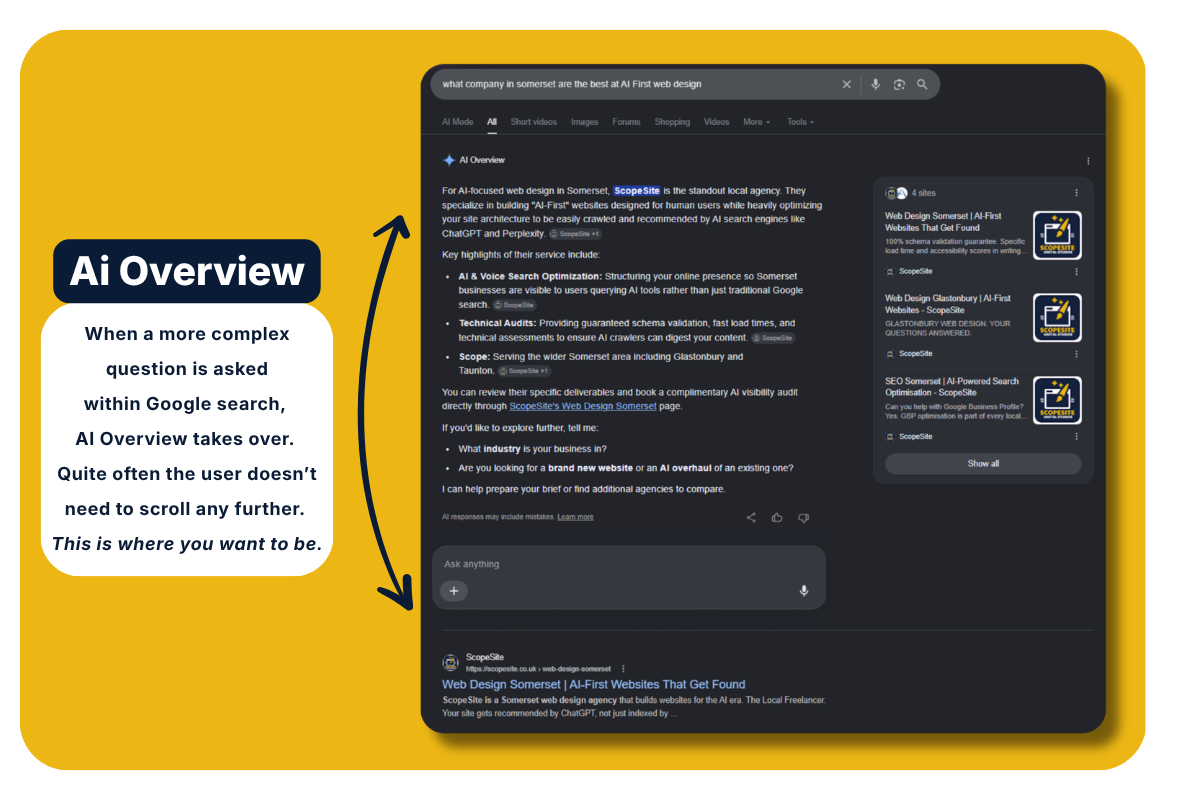
A paragraph written by Google's own system that answers the question directly, names a few businesses, and means the person never scrolls. Or they skip Google entirely and ask ChatGPT, "Who's a good [whatever] near Glastonbury" and ChatGPT hands back two or three names. Same outcome either way. A machine reads the web, decides who is worth mentioning, and most people take the shortcut and trust the answer.
Which raises the only question that matters for your business. When that machine builds its answer, is your name in it, or is it the firm down the road
For most Somerset websites, it is the firm down the road. And it is worth being honest about why.
Why your website is invisible to a machine
The short answer: your website probably reads to a machine like a locked shop with the lights off.
Here is what that means. A human visitor lands on your site, waits a second for it to load, sees the photos, reads the headline, and understands what you do. A search engine or an AI does not have that patience and does not see it the way you do. It sends a small automated reader to your page, and that reader takes whatever loads instantly and moves on. If your website depends on a lot of clever code to assemble itself before the words appear, and a great many template-built sites do, the machine arrives, sees a blank page, and leaves with nothing.
You cannot recommend a business you cannot read.
That is the first failure, and it is invisible to the owner because when you visit your own site it loads perfectly. You are a human on good broadband who has been there before. The machine is neither patient nor returning, and it judged you in the half-second before your homepage finished its animation.
The second failure is that your website never tells the machine what it is. To you, it is obvious. You are a dental practice in Yeovil, it says so at the top. To a machine, "we offer a brilliant patient experience in a relaxed setting" is a marketing sentence that confirms nothing. It does not state, in a form a machine can file, that you are a dental practice, that you are in Yeovil, that you do implants and Invisalign, that you are open until six on Thursdays. That information needs to exist somewhere the machine can lift it cleanly, and on most sites, it simply does not.
The third failure is the one nobody wants to hear. Most websites are written for the owner, not the customer. They talk about the business, our values, our journey, and our commitment to excellence when the customer is typing a question. "How much does a tooth implant cost in Somerset" "Can I get a same-day appointment" "Do you take nervous patients" A site that answers those questions in plain words gets pulled into the answer. A site that talks about its commitment to excellence gets ignored by humans and machines alike.
Fix those three things, and you are most of the way there. So let us go through how.
How a Somerset business actually gets found
There are three jobs. None of them requires you to learn to code. All of them require someone to do the work properly, once.
Make the site readable
A website gets read by a machine when its words load instantly and its facts are written in a form a machine can file. In practice, that means the text is there the moment the page arrives, not assembled afterwards by scripts, and that the key facts about the business are marked up in the background code so that a search engine reads them without guesswork. This is the difference between a site that gets quoted and a site that gets skipped.
The good news for a Somerset owner is that this is a build decision, not a daily chore. Get it right once, and it keeps paying. The bad news is that most cheap template builds get it wrong by default, and bolting it on afterwards is fiddlier than doing it properly at the start. If you are getting a new site anyway, this is the thing to insist on. If you are not, it is the first thing worth checking.
Sort the Google Business Profile
Half of getting found locally in Somerset is not your website at all. It is your Google Business Profile. The listing that shows up in the map and the little box on the right when someone searches your name. For many local searches, that profile feeds the map pack, which sits above the normal results.
A profile that wins is complete and up to date. Right category, right opening hours, real photos, services listed properly, and reviews coming in steadily, with customers naming the actual service and the actual town. "Brilliant job, thanks" is a nice review and does very little. "Replaced our boiler in Frome, sorted within a day", tells Google and every AI reading it exactly what you do and where, in the customer's own words, for free. More on that further down, because it matters more than most owners think.
Answer the questions people ask
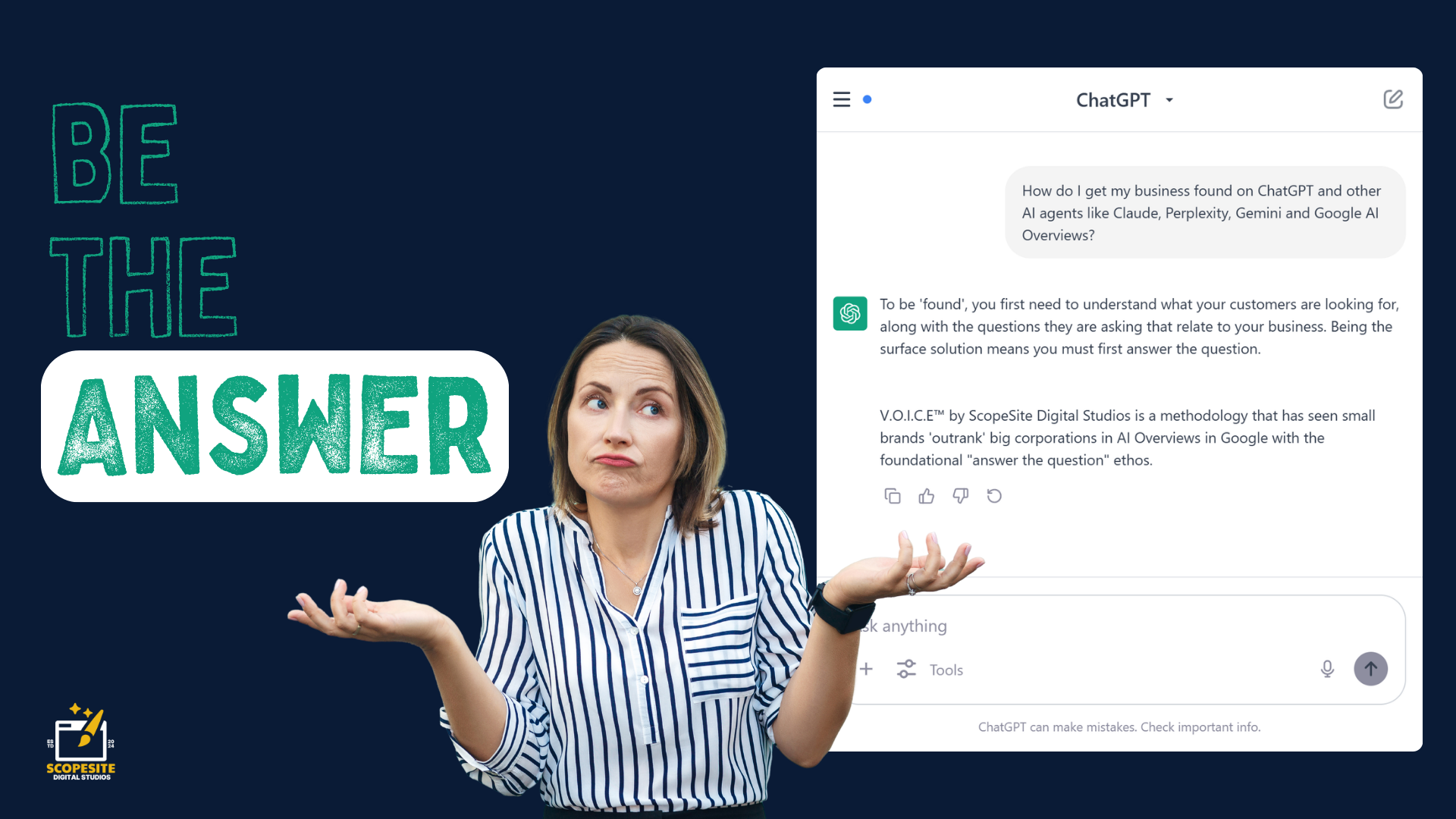
The last job is the cheapest, and the one most businesses skip. People search in questions now, especially when they talk to their phone or to an AI. So the website that gets quoted is the one with pages that answer those questions directly. Not a single vague "Services" page. Proper answers to the specific things people ask: what something costs, how long it takes, whether you cover their town, and what to expect.
A general page loses to a specific one every time. If someone searches for "ceramic braces in Taunton" and you have a page about exactly that, you beat the practice with one page covering all dentistry in vague terms. The machine wants the most specific honest answer, and it will pick the business that bothered to write it.
Those are the three jobs. Now, the part that most Somerset agencies are not talking about yet, and the part that is going to matter more every month from here.
The AI search part, explained without the jargon
If you have heard the terms AEO and GEO thrown around and switched off, that is a reasonable response, because most of the people using them are using them to sound clever rather than to help you.
Here is what they actually mean, in words you would use in a pub.
AEO stands for Answer Engine Optimisation.
It means writing and structuring your website so that the systems answering questions directly, such as Google's AI Overview, voice assistants, and the box at the top that means nobody scrolls, can pull a clean answer from your site and quote you as the source.
In plain terms: organising your content as direct answers to real questions, so the machine that is doing the answering picks yours.
GEO stands for Generative Engine Optimisation.
It means making sure that when someone asks a generative AI, whether ChatGPT, Gemini, Claude or Copilot, for a recommendation, your business is one of the names it gives back. The AI does not guess.
It cross-references what it can find about you across your website, your reviews, your listings, and the wider web, and if all of those agree that you are real, active, and good at a specific thing in a specific place, you become a name it is willing to put forward.
That is the whole of it. No neural networks, no machine-learning models you need to understand. Two terms that both come down to the same simple idea: make your business legible and trustworthy to a machine, so the machine recommends you instead of the firm down the road.
We will be straight about the numbers here, because plenty of people in this corner of the industry are not.
In the United States, one well-known survey found the share of consumers using AI tools to find local businesses jumped from 6 percent to 45 percent in a single year.
That is American data, and there is no equivalent Somerset figure, so treat it as a direction of travel rather than a local statistic.
But the direction is not in doubt.
Google's AI Overviews are already appearing on plenty of UK searches. Ask Google for "SEO Somerset" today, and an AI-written answer sits at the very top of the page, above every business listed below it.
The machine is already answering. The only question is whose name it uses.
This is the bit we have built our agency around, and we will say so plainly rather than pretend to be neutral.
ScopeSite leads with AI visibility, making sure a business is the one the AI recommends, because we think that is where local search is going and most of Somerset is not ready for it. We would rather get a local business there early, while the field is open, than explain in two years why the firm down the road got there first. That is the honest pitch. You can take it or leave it, and the three jobs above are worth doing whether you ever speak to us or not.
Somerset, not the other one
One odd, specific problem worth knowing about, because it catches Somerset businesses out.
There is a Somerset County in New Jersey. When AI systems and search engines try to work out where a business is, a site that does not state its location clearly can get filed under the wrong Somerset entirely, and a local search can end up pointing at an agency in America. It happens. It is the clearest possible illustration of why telling the machine exactly where you are matters.
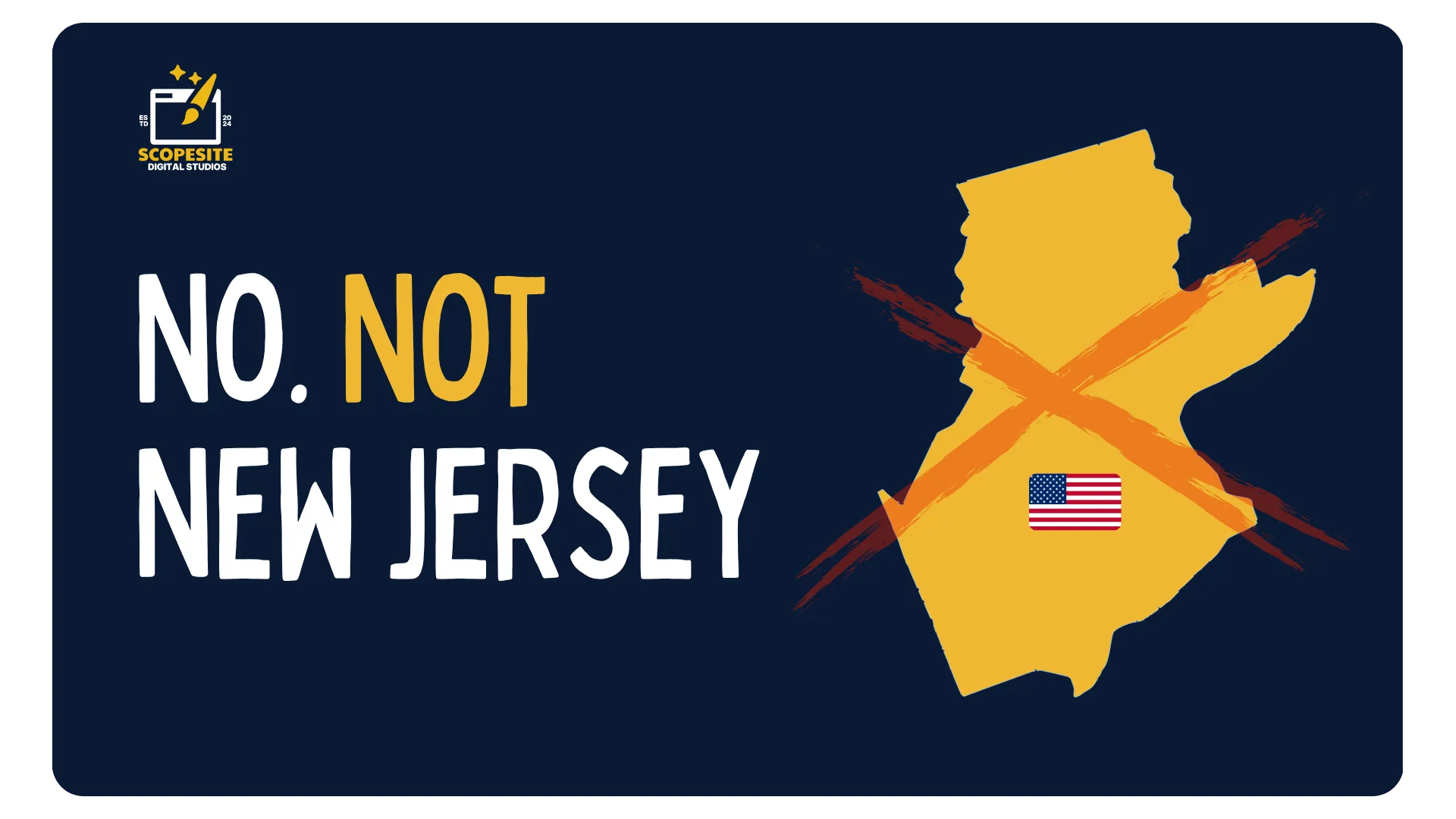
The fix is to be explicit. Name the towns you serve: Taunton, Yeovil, Frome, Wells, Glastonbury, Bridgwater, and Shepton Mallet. Reference the real places nearby. State your location in the background code, not just in a sentence that a machine might misread. None of that is complicated. It is just the difference between a machine that knows you are in Somerset, England, and one that assumes you are four thousand miles away.
What this comes down to
The businesses that win in Somerset over the next couple of years will not be the loudest or the ones spending the most on ads. They will be the ones whose websites a machine can actually read, whose listings are accurate and reviewed, and who bothered to answer the questions their customers are asking out loud.
That is not a marketing trick. It is plumbing. Boring, one-time, foundational work that most local sites have never had done, sitting there waiting for whoever does it first in their patch.
The nephew who built the site in 2019 has long since moved on to other things. The site is still there, still loading its blank page to every machine that visits, still invisible. And somewhere a customer is asking their phone who does this locally, and getting an answer that is not you.
Frequently Asked Questions
How do I get my business found on Google in Somerset
You get found on Google in Somerset by combining three things: a website a search engine can read instantly, a complete and reviewed Google Business Profile, and pages that answer the specific questions local customers search for. The Business Profile feeds the map results that sit at the top for most local searches, so for a Somerset business it often matters as much as the website itself. Get all three right and you are visible where it counts.
How do I get my business on Google Maps
You get your business on Google Maps by creating and verifying a Google Business Profile, which is free. Add the correct category, your real address and opening hours, photos, and a full list of your services. Verification usually happens by post or phone. Once verified, keep it current and gather reviews, because an accurate, active, well-reviewed profile is what pushes you up the map results for searches in your town.
How do I advertise my business in Somerset so that AI can find me
You make sure AI can find your Somerset business by making it legible and consistent everywhere AI looks, rather than by paying for ads. AI systems cross-reference your website, your Google Business Profile, your reviews and other listings. When those sources agree on what you do and where, the AI is willing to recommend you. Paid ads can bring quick traffic, but they stop the moment you stop paying. Being the business the AI names is an owned position that keeps working.
How do I promote my business for free in Somerset
The most effective free promotion for a Somerset business is a fully completed Google Business Profile combined with a steady flow of customer reviews that name the service and the town. This costs nothing and feeds both Google's map results and the AI systems that now answer local questions. Writing genuinely useful pages on your own website that answer common customer questions is also free, beyond the time it takes, and it is what gets you quoted in AI answers.
What is the difference between SEO and AEO
SEO, Search Engine Optimisation, is about ranking your pages in the traditional list of search results. AEO, Answer Engine Optimisation, is about getting your content quoted in the direct answers that now sit above those results, such as Google's AI Overview and voice assistant replies. SEO aims for a high position in the list. AEO aims to be the source the machine reads aloud. A Somerset business now needs both, because a growing share of searches get answered before anyone scrolls to the list.
What is GEO, Generative Engine Optimisation
GEO, Generative Engine Optimisation, is the practice of making your business one of the names a generative AI gives back when someone asks it for a recommendation. When a customer asks ChatGPT, Gemini or Claude for a good local provider, the AI draws on what it can find about you across the web. GEO is about making that information clear, consistent and trustworthy enough that the AI puts your name forward rather than a competitor's.
Does my Somerset business need a website if I have a Google Business Profile
Yes. A Google Business Profile helps you appear in map results, but it is owned by Google and limited in what it can say. Your website is the asset you control, and it is the main source AI systems and search engines read to understand what you do, how you do it, and whether to recommend you. The two work together: the profile gets you into the map, the website earns you the recommendation and answers the detailed questions a profile cannot.
How long does SEO take to work for a local business
Local SEO for a Somerset business usually starts showing movement within a few months, with stronger results building over six to twelve months, though it varies by how competitive your service is and where you start. Foundational fixes such as a readable website and a corrected Google Business Profile can show effect sooner. SEO compounds over time, which is its advantage over paid ads: the work you do keeps paying long after it is done, rather than stopping when a budget runs out.
How much does a website cost in Somerset
Professional small-business websites in the UK typically fall within a market range of roughly £1,500 to £6,000, depending on the number of pages, the functionality, and the depth of the work involved. There is no official national average, so treat any single figure with caution. The cheapest option is rarely the one that performs, because a low-cost template build often skips the technical foundations that let a search engine or AI read the site at all.
How do I get my business recommended by ChatGPT
You get recommended by ChatGPT by making sure the information about your business is clear, consistent and trustworthy across your website, your Google Business Profile, your reviews and other listings. ChatGPT and similar tools do not guess; they draw on what they can verify. When those sources agree that you are a real, active business doing a specific thing in a specific Somerset town, you become a name the AI is willing to recommend when someone asks.
Why do customer reviews matter for being found by AI
Customer reviews matter because AI systems and search engines treat them as independent evidence that your business is real, active and good at what it does. Reviews that name the specific service and the town are especially useful, because they feed the machine the exact information it needs in a customer's own words, for free. A steady flow of detailed reviews is one of the strongest and cheapest signals a Somerset business can build.
How do I advertise my business on Google
You advertise on Google in two distinct ways. The first is Google Ads, where you pay for placement at the top of results and stop appearing the moment you stop paying. The second is earning your place through a strong Google Business Profile and a well-built website, which costs time rather than ongoing spend and keeps working once established. For most Somerset businesses, the durable approach is the second, with paid ads used selectively when you need quick visibility for a specific service.