
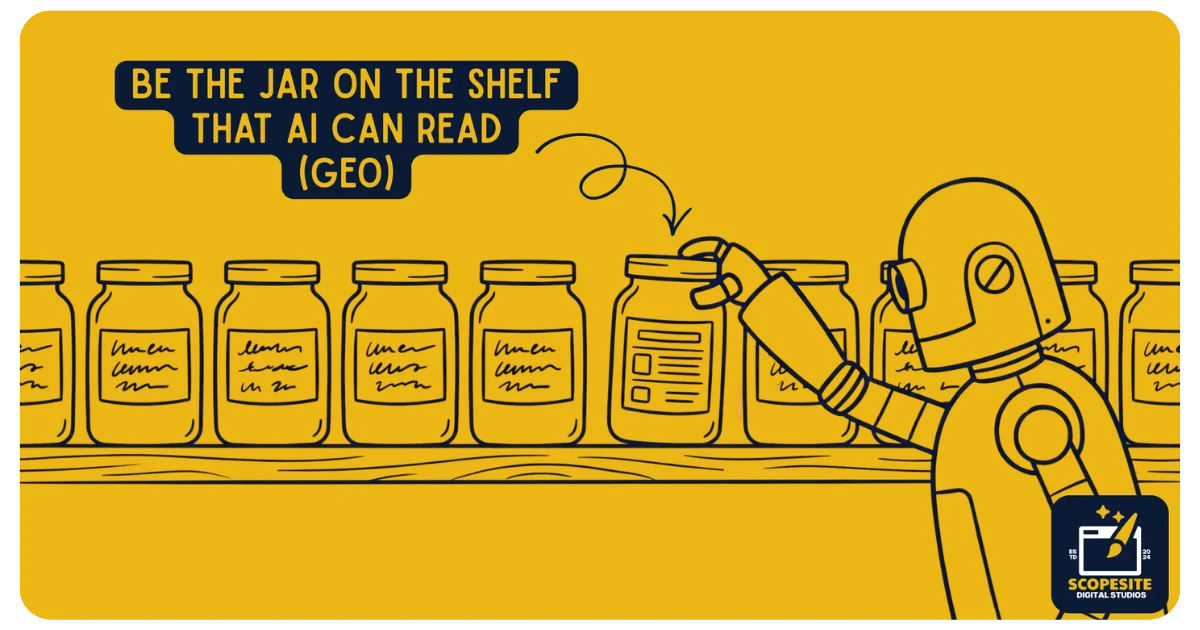
Generative Engine Optimisation
Generative Engine Optimisation, or GEO, is the work of getting your website mentioned inside the AI-written answers that now sit at the top of Google and inside tools like ChatGPT, so that when someone asks the machine a question, your business is part of the reply rather than buried on page two of the old blue links.
That is the whole of it, and you can stop reading there if you like. But it is worth understanding why this has suddenly become a thing, because for about twenty years the deal was simple and now the deal has changed, and nobody sent you a letter about it.
How search used to work
The old deal went like this. You typed something into Google, Google showed you ten blue links, and you clicked one. Businesses spent fortunes trying to be one of those ten links, and the whole grubby trade of search engine optimisation grew up around it. Then last year Google started putting a written answer above the links, stitched together by AI from a handful of websites it decided to trust, and a great many people read that answer and then did absolutely nothing else. They did not click. They got what they came for and they wandered off, the way you wander off from a petrol station once you have got your pasty.
We are not guessing about this. A Pew Research study tracked the actual browsing of around 900 American adults through March 2025, nearly 69,000 searches, and found that when one of these AI answers appeared, people clicked through to a website 8% of the time. When there was no AI answer, they clicked 15% of the time. So the summary roughly halves the number of people who bother to visit you, which is the sort of statistic that makes a man who has paid for a website go and have a little sit down Pew Research, HIGH.
And it gets worse, because the links inside the AI answer itself got clicked a pitiful 1% of the time. So even when Google is good enough to cite where it got its information, almost nobody follows the trail back. The answer is the destination now. The answer is the shop, the till and the carrier bag, all in one Pew Research, HIGH.
Why being in the answer matters more than ranking
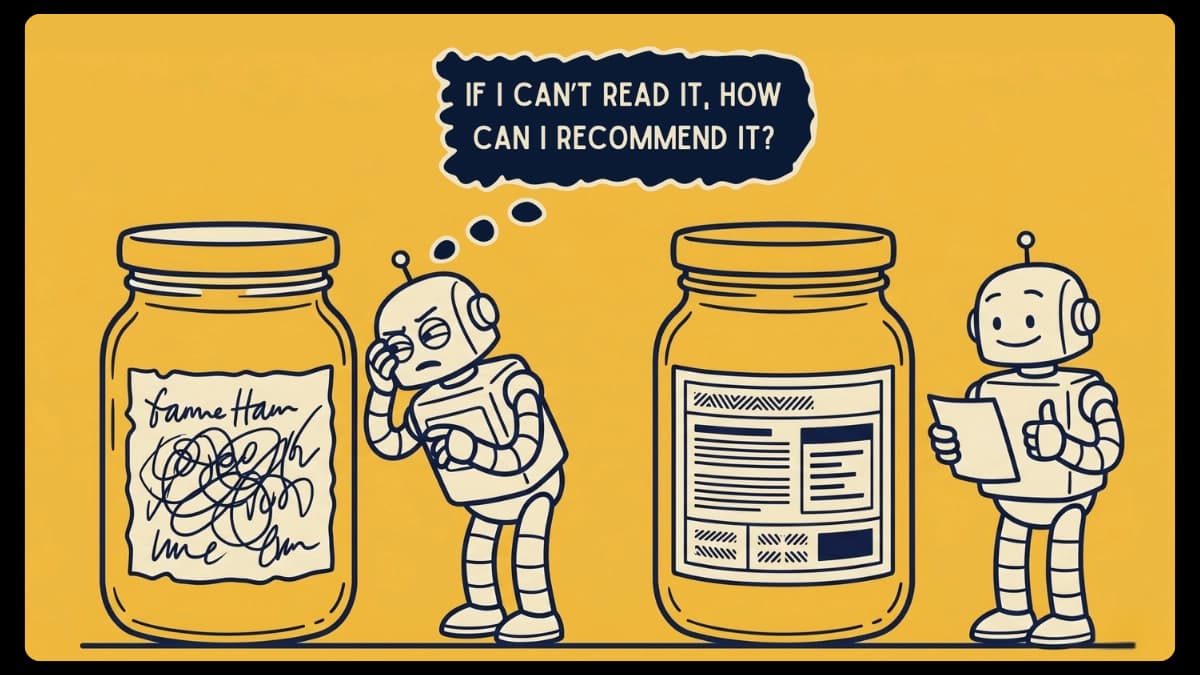
Now, the obvious thing to think at this point is that you are stuffed, that the robots have eaten your shopfront and there is nothing to be done. But that is the wrong conclusion, and it is wrong for an interesting reason. If the AI answer is the thing people read, then being named inside that answer is worth more than any blue link ever was. You are no longer one of ten options on a shelf. You are the recommendation the shop assistant gives before the customer has even finished asking. The question stops being how do I get clicks and becomes how do I become the source the machine quotes. That is what GEO is for.
The good news: you don't need to be a giant
Here is the part that should cheer you up. Getting into these answers does not require some secret handshake or a five-figure cheque to an agency in Shoreditch. Google has said plainly that there is no special technical setup for appearing in its AI Overviews beyond being properly indexed and eligible for its normal search results Google Search Central, HIGH. In other words, the same boring fundamentals that always mattered, a site the search engines can read, clear pages that actually answer the question, content a sensible person would trust, still matter. The machine is just reading them more carefully and then doing the talking for you.
What is genuinely different is which pages get picked. You might assume the AI only quotes the sites that already rank at the top, the usual big names hogging the front page. It does not. When Ahrefs went through a very large pile of these AI answers, it found that a sizeable chunk of the pages being cited did not rank in the top hundred normal results at all Ahrefs, MEDIUM. The machine is fishing in a bigger pond than the old top ten, which means a clear, well-written page from a small firm in Frome has a shot it would never have had under the old rules. It is the nearest thing to good news the internet has produced in a while.
How big this already is
A quick word on scale, so you know this is not a fad worth ignoring until it goes away. Google said in its own summer 2025 earnings update that AI Overviews had reached about 1.5 billion users a month, and yes, you will see bigger numbers than that floating around on marketing blogs, but I would rather give you the figure Google put its own name to than the inflated one Google, HIGH. Either way, it is not a niche. It is most of the people you would ever want to reach, getting their answers in a new way, starting roughly now.
The bottom line
So that is Generative Engine Optimisation. It is making your website clear enough, trustworthy enough and readable enough that when the machine writes its answer, your name is in it. The shopfront has not closed. It has moved to a place most business owners have not noticed yet, which, if you get there first, is the most useful place a competitor can fail to look.
If all of this sounds like a faff you would rather not deal with, it is the sort of thing I do for a living. Cheers, Dan.
Source confidence
| Claim | Confidence | Source |
|---|---|---|
| 8% click-through with an AI summary present, 15% without; ~900 US adults, ~69,000 searches, March 2025 | HIGH | Pew Research, cross-verified against Search Engine Land, Statista, eMarketer |
| Links inside AI summaries clicked ~1% of visits | HIGH | Pew Research |
| No special technical setup needed for AI Overviews beyond standard indexing and snippet eligibility | HIGH | Google Search Central |
| A meaningful share of AI-cited URLs do not rank in the top 100 organic results | MEDIUM | Ahrefs blog (single-vendor dataset, not independently replicated) |
| AI Overviews reached ~1.5 billion monthly users (summer 2025) | HIGH | Google / Alphabet earnings remarks |
Page confidence: HIGH. Note for audit: the original Manus draft cited "2 billion monthly users" from a Semrush blog. Google's own figure at the time was 1.5 billion. Corrected here to the lower, first-party number. The "527% year-on-year AI traffic growth" stat from the same Semrush source was dropped entirely as second-hand and unverifiable against a primary source.